Pearson+ LogoPearson+ Logo
Ch. 23 Circulation
Taylor - Campbell Biology: Concepts & Connections 10th Edition
Taylor, Simon, Dickey, Hogan10th EditionCampbell Biology: Concepts & ConnectionsISBN: 9780136538783Not the one you use?Change textbook
Chapter 23, Problem 12

Explain how the structure of capillaries relates to their function of exchanging substances with the surrounding interstitial fluid. Describe how that exchange occurs.

Verified step by step guidance
1
Understand the structure of capillaries: Capillaries are the smallest blood vessels in the body, with a diameter just large enough to allow red blood cells to pass through one at a time. Their walls are made of a single layer of endothelial cells, which makes them extremely thin.
Recognize the significance of the thin walls: The thinness of the capillary walls facilitates the exchange of substances between the blood in the capillaries and the surrounding interstitial fluid. This thin barrier allows substances such as oxygen, carbon dioxide, nutrients, and waste products to pass through easily.
Learn about the types of capillary exchange: The exchange of substances across capillary walls can occur through several mechanisms including diffusion, filtration, and osmosis. Diffusion allows for the movement of substances down their concentration gradient, while filtration and osmosis involve the movement of fluid and solutes under pressure.
Consider the role of capillary pores: Some capillaries have small pores or gaps between the endothelial cells, known as fenestrations. These pores allow for a more rapid exchange of water and smaller solutes between blood and interstitial fluid, which is crucial in organs that require rapid absorption or filtration, like the kidneys and intestines.
Reflect on the overall function: The structure and properties of capillaries are crucial for their role in microcirculation, where they serve as the primary site for the exchange of nutrients and wastes between blood and tissues. This exchange is essential for maintaining cellular environments and overall homeostasis in the body.

Verified video answer for a similar problem:

This video solution was recommended by our tutors as helpful for the problem above.
Video duration:
1m
Was this helpful?

Key Concepts

Here are the essential concepts you must grasp in order to answer the question correctly.

Capillary Structure

Capillaries are the smallest blood vessels in the body, characterized by their thin walls composed of a single layer of endothelial cells. This minimal thickness facilitates efficient diffusion of substances, such as oxygen, carbon dioxide, nutrients, and waste products, between the blood and surrounding tissues. The narrow diameter of capillaries also ensures that red blood cells pass through in single file, maximizing surface area for exchange.
Recommended video:
Guided course
04:25
Community Structure

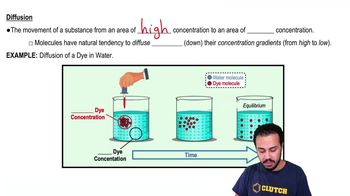
Diffusion

Diffusion is the process by which molecules move from an area of higher concentration to an area of lower concentration. In the context of capillaries, oxygen and nutrients diffuse from the blood, where they are in higher concentration, into the interstitial fluid and then into surrounding cells. Conversely, waste products like carbon dioxide diffuse from the cells into the capillaries, where their concentration is lower, allowing for efficient exchange.
Recommended video:

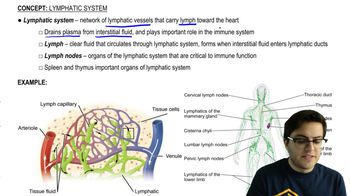
Interstitial Fluid

Interstitial fluid is the fluid that surrounds cells in tissues, acting as a medium for the exchange of substances between blood and cells. It contains nutrients, hormones, and waste products, facilitating the transport of these materials to and from cells. The composition and volume of interstitial fluid are crucial for maintaining homeostasis, as they directly influence cellular function and overall tissue health.
Recommended video:
Guided course
02:15
Lymphatic System
Related Practice
Textbook Question
Trace the path of blood starting in a pulmonary vein, through the heart, and around the body, returning to the pulmonary vein. Name, in order, the heart chambers and types of vessels through which the blood passes.
2013
views
Textbook Question

If blood were supplied to all of the body's capillaries at one time,

a. Blood pressure would fall dramatically.

b. Resistance to blood flow would increase.

c. Blood would move too rapidly through the capillaries.

d. The amount of blood returning to the heart would increase.

1206
views
Textbook Question
If a blood clot forms inside a vein in the leg, it may travel through the circulatory system. What is the first capillary bed the clot would reach, where it might block blood flow?
1200
views
Textbook Question
Here is a blood sample that has been spun in a centrifuge. List, as completely as you can, the components you would find in the straw-colored fluid at the top of this tube and in the dense red portion at the bottom.

1798
views
Textbook Question
Some babies are born with a small hole in the wall between the left and right ventricles. How might this affect the oxygen content of the blood pumped out of the heart into the systemic circuit?
917
views
Textbook Question
Juan has a disease in which damaged kidneys allow some of his normal plasma proteins to be removed from the blood. How might this condition affect the osmotic pressure of blood in capillaries, compared with that of the surrounding interstitial fluid? One of the symptoms of this kidney malfunction is an accumulation of excess interstitial fluid, which causes Juan's arms and legs to swell. Can you explain why this occurs?
828
views