
Pearson+ LogoPearson+ Logo
Ch. 23 Circulation
Taylor - Campbell Biology: Concepts & Connections 10th Edition
Taylor, Simon, Dickey, Hogan10th EditionCampbell Biology: Concepts & ConnectionsISBN: 9780136538783Not the one you use?Change textbook
Chapter 23, Problem 11

If a blood clot forms inside a vein in the leg, it may travel through the circulatory system. What is the first capillary bed the clot would reach, where it might block blood flow?

Verified step by step guidance
1
Identify the starting point of the clot, which is in a vein in the leg. This vein is part of the systemic venous system that returns deoxygenated blood back to the heart.
Understand that the blood from the leg veins travels upwards towards the heart, entering the inferior vena cava, which carries the blood to the right atrium of the heart.
Recognize that from the right atrium, the blood moves into the right ventricle, which then pumps it into the pulmonary arteries.
Note that the pulmonary arteries lead the blood to the lungs. Here, the blood enters the pulmonary capillaries, which are the first capillary beds it encounters.
Consider that the pulmonary capillaries are where gas exchange occurs (oxygen in, carbon dioxide out), and this is the most likely place for a clot traveling from the leg to first potentially block blood flow.

Verified video answer for a similar problem:

This video solution was recommended by our tutors as helpful for the problem above.
Video duration:
2m
Was this helpful?

Key Concepts

Here are the essential concepts you must grasp in order to answer the question correctly.

Circulatory System

The circulatory system is a complex network that transports blood throughout the body, delivering oxygen and nutrients to tissues while removing waste products. It consists of the heart, blood vessels, and blood. Understanding this system is crucial for identifying how a blood clot can travel and where it may cause blockages.
Recommended video:
Guided course
02:15
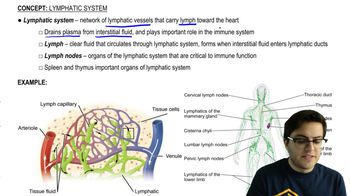
Lymphatic System

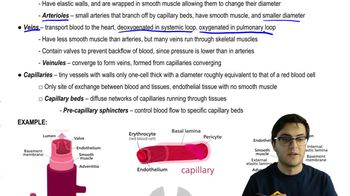
Capillary Beds

Capillary beds are networks of tiny blood vessels where the exchange of gases, nutrients, and waste occurs between blood and tissues. They are the smallest and most numerous blood vessels in the body. The first capillary bed a clot would encounter after leaving a vein is essential for understanding potential blockages and their consequences.
Recommended video:

Venous Return

Venous return refers to the process by which deoxygenated blood returns to the heart through veins. Blood clots that form in the veins can travel back to the heart and then into the pulmonary circulation. Recognizing the pathway of venous return helps in determining the first capillary bed a clot would reach, which is typically in the lungs.
Recommended video:
Guided course
02:25
Biogeochemical Cycles Example 4
Related Practice
Textbook Question

Which of the following is not a true statement about open and closed circulatory systems?

a. Both systems have some sort of a heart that pumps a circulatory fluid through the body.

b. A frog has an open circulatory system; other vertebrates have closed circulatory systems.

c. The blood and interstitial fluid are separate in a closed system but are indistinguishable in an open system.

d. Some of the circulation of blood in both systems results from body movements.

1673
views
Textbook Question
Trace the path of blood starting in a pulmonary vein, through the heart, and around the body, returning to the pulmonary vein. Name, in order, the heart chambers and types of vessels through which the blood passes.
2013
views
Textbook Question

If blood were supplied to all of the body's capillaries at one time,

a. Blood pressure would fall dramatically.

b. Resistance to blood flow would increase.

c. Blood would move too rapidly through the capillaries.

d. The amount of blood returning to the heart would increase.

1206
views
Textbook Question
Explain how the structure of capillaries relates to their function of exchanging substances with the surrounding interstitial fluid. Describe how that exchange occurs.
1554
views
Textbook Question
Here is a blood sample that has been spun in a centrifuge. List, as completely as you can, the components you would find in the straw-colored fluid at the top of this tube and in the dense red portion at the bottom.

1798
views
Textbook Question
Some babies are born with a small hole in the wall between the left and right ventricles. How might this affect the oxygen content of the blood pumped out of the heart into the systemic circuit?
917
views