Pearson+ LogoPearson+ Logo
Ch. 15 Tracing Evolutionary History
Taylor - Campbell Biology: Concepts & Connections 10th Edition
Taylor, Simon, Dickey, Hogan10th EditionCampbell Biology: Concepts & ConnectionsISBN: 9780136538783Not the one you use?Change textbook
Chapter 15, Problem 18

When Stanley Miller's experiment was published in 1953, his results made global headlines. The general public thought Miller had answered the question of how life on Earth began by creating life in a test tube. However, scientists understood that Miller's experiment was neither a final answer nor a recipe for life. Rather, it was the first test of a long-standing hypothesis about the origin of life. Write an essay describing how the process of science progresses over time toward understanding how nature works.

Verified step by step guidance
1
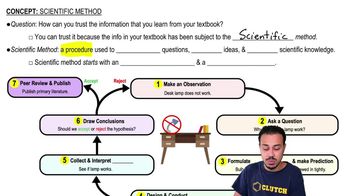
Start by explaining the scientific method, which is a systematic process involving observation, hypothesis formation, experimentation, and analysis to understand natural phenomena.
Describe how Stanley Miller's experiment was a test of the hypothesis that organic molecules necessary for life could form under early Earth conditions. Highlight the importance of testing hypotheses in science.
Discuss how scientific understanding evolves over time, emphasizing that Miller's experiment was a starting point that inspired further research into the origin of life, such as the study of RNA world hypothesis and hydrothermal vent theories.
Explain that science is a collaborative and iterative process, where new evidence and technologies refine or challenge existing ideas, leading to a deeper understanding of complex questions like the origin of life.
Conclude by emphasizing that science does not provide absolute answers but builds a body of evidence over time, with each experiment contributing to a larger framework of understanding.

Verified video answer for a similar problem:

This video solution was recommended by our tutors as helpful for the problem above.
Video duration:
1m
Was this helpful?

Key Concepts

Here are the essential concepts you must grasp in order to answer the question correctly.

Hypothesis Testing

Hypothesis testing is a fundamental aspect of the scientific method, where scientists propose explanations for natural phenomena that can be tested through experiments. In the context of Miller's experiment, it served as a test of the hypothesis that organic compounds necessary for life could form under prebiotic conditions. This process allows for the refinement of ideas based on empirical evidence, leading to a deeper understanding of complex biological origins.
Recommended video:

Scientific Progression

Scientific progression refers to the iterative nature of scientific inquiry, where knowledge builds upon previous findings. As new experiments are conducted and technologies advance, theories are revised or replaced, leading to a more comprehensive understanding of natural processes. Miller's experiment exemplifies this, as it sparked further research and debate about the origins of life, illustrating how science evolves over time.
Recommended video:
Guided course
06:29
Scientific Method

Public Perception vs. Scientific Understanding

The distinction between public perception and scientific understanding highlights the gap that can exist between lay interpretations of scientific findings and the nuanced realities understood by scientists. While the public may view Miller's experiment as a definitive answer to the origins of life, scientists recognize it as a significant but preliminary step in a much larger inquiry. This concept underscores the importance of science communication in accurately conveying the complexities of scientific research.
Recommended video:
Guided course
06:29
Scientific Method