Pearson+ LogoPearson+ Logo
Ch. 15 Tracing Evolutionary History
Taylor - Campbell Biology: Concepts & Connections 10th Edition
Taylor, Simon, Dickey, Hogan10th EditionCampbell Biology: Concepts & ConnectionsISBN: 9780136538783Not the one you use?Change textbook
Chapter 15, Problem 17

A paleontologist compares fossils from three dinosaurs and Archaeopteryx, the earliest-known bird. The following table shows the distribution of characters for each species, where 1 means that the character is present and 0 means it is not. The outgroup (not shown in the table) had none of the characters. Arrange these species on the phylogenetic tree below and indicate the derived character that defines each branch point.
Table showing traits of Velociraptor, Coelophysis, Archaeopteryx, and Allosaurus for phylogenetic analysis.

Verified step by step guidance
1
Step 1: Begin by identifying the derived characters (traits) in the table. Derived characters are traits that are present in some species but absent in the outgroup. In this case, the traits are hollow bones, three-fingered hand, half-moon-shaped wrist bone, and reversed first toe.
Step 2: Determine the order in which the derived characters evolved by analyzing their distribution across the species. Traits shared by more species likely evolved earlier, while traits unique to fewer species evolved later. For example, hollow bones are present in all species, so this trait likely evolved first.
Step 3: Place the species on the phylogenetic tree based on shared derived characters. Start with the outgroup at the base, which has none of the traits. The first branch point is defined by the presence of hollow bones, which includes all species. The next branch point is defined by the three-fingered hand, present in Velociraptor, Archaeopteryx, and Allosaurus.
Step 4: Continue branching based on the presence of additional derived characters. The half-moon-shaped wrist bone is present in Velociraptor and Archaeopteryx, defining the next branch point. Finally, the reversed first toe is unique to Archaeopteryx, placing it on its own branch.
Step 5: Label each branch point on the phylogenetic tree with the derived character that defines it. For example, the first branch point is labeled 'hollow bones,' the second 'three-fingered hand,' the third 'half-moon-shaped wrist bone,' and the fourth 'reversed first toe.' Ensure the species are arranged correctly based on their shared traits.

Verified video answer for a similar problem:

This video solution was recommended by our tutors as helpful for the problem above.
Video duration:
1m
Was this helpful?

Key Concepts

Here are the essential concepts you must grasp in order to answer the question correctly.

Phylogenetic Tree

A phylogenetic tree is a diagram that represents the evolutionary relationships among various biological species based on their shared characteristics. It illustrates how species diverged from common ancestors over time, with branches indicating lineage splits. Understanding how to read and construct these trees is essential for analyzing evolutionary data, such as the traits of different dinosaur species and their relation to Archaeopteryx.
Recommended video:
04:13
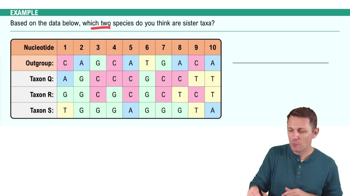
Building Phylogenetic Trees Example 2

Derived Characters

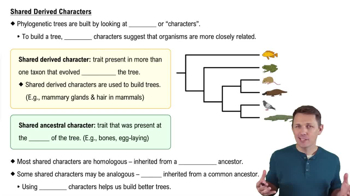
Derived characters are traits that are present in a group of organisms but absent in their last common ancestor. These traits help define the branches of a phylogenetic tree, indicating evolutionary changes that have occurred. Identifying derived characters is crucial for determining the relationships between species, as they provide insight into how certain traits evolved and which species share more recent common ancestors.
Recommended video:
05:42
Shared Derived Characters

Outgroup Comparison

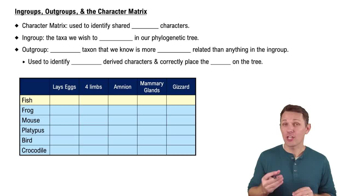
An outgroup is a species or group of species that is closely related to the group being studied but is not part of it. It serves as a reference point for determining the evolutionary relationships and character states of the ingroup species. By comparing the traits of the outgroup with those of the ingroup, researchers can infer which traits are ancestral and which are derived, aiding in the construction of a more accurate phylogenetic tree.
Recommended video:
10:06
Ingroups, Outgroups, & the Character Matrix