Pearson+ LogoPearson+ Logo
Ch. 15 Tracing Evolutionary History
Taylor - Campbell Biology: Concepts & Connections 10th Edition
Taylor, Simon, Dickey, Hogan10th EditionCampbell Biology: Concepts & ConnectionsISBN: 9780136538783Not the one you use?Change textbook
Chapter 15, Problem 15

What types of molecular comparisons are used to determine the very early branching of the tree of life? Explain.

Verified step by step guidance
1
Identify the types of molecules that can be compared across different species. Common molecules used in these comparisons include DNA, RNA, and proteins.
Understand the importance of highly conserved genes, which are genes that have remained relatively unchanged throughout evolution. These genes are ideal for studying early evolutionary relationships because they are present in a wide range of organisms.
Examine ribosomal RNA (rRNA) sequences, which are often used for studying early divergences in the tree of life. rRNA plays a crucial role in protein synthesis in all living organisms and has regions that are highly conserved and some that are variable.
Consider the use of mitochondrial DNA (mtDNA) and chloroplast DNA (cpDNA) for molecular comparisons. These organelle genomes are inherited maternally in most organisms and can provide insights into the maternal lineage and evolutionary history.
Explore the application of bioinformatics tools and phylogenetic analysis to compare these molecular sequences across different organisms. This analysis helps in constructing a phylogenetic tree that represents the evolutionary relationships and helps in understanding the early branching patterns of the tree of life.

Verified video answer for a similar problem:

This video solution was recommended by our tutors as helpful for the problem above.
Video duration:
2m
Was this helpful?

Key Concepts

Here are the essential concepts you must grasp in order to answer the question correctly.

Molecular Phylogenetics

Molecular phylogenetics is the study of evolutionary relationships among biological entities, often using molecular data such as DNA, RNA, or protein sequences. By comparing these molecular sequences across different organisms, scientists can infer how closely related they are and construct a 'tree of life' that illustrates these relationships. This approach is particularly useful for understanding early branching events in evolution.
Recommended video:
05:13
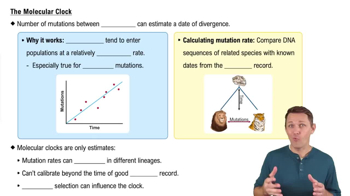
The Molecular Clock

Genetic Markers

Genetic markers are specific sequences in the genome that can be used to identify and compare different species or populations. These markers can include single nucleotide polymorphisms (SNPs), insertions, deletions, or entire genes. By analyzing these markers, researchers can trace lineage and divergence, providing insights into the early branches of the tree of life.
Recommended video:

Molecular Clock

The molecular clock is a technique that uses the mutation rates of biomolecules to estimate the time of divergence between species. By assuming a constant rate of mutation, scientists can calculate when two species last shared a common ancestor. This method is crucial for placing early branching events in the context of evolutionary time, helping to clarify the relationships among the earliest forms of life.
Recommended video:
05:13
The Molecular Clock
Related Practice
Textbook Question
Which are more likely to be closely related: two species with similar appearance but divergent gene sequences or two species with different appearances but nearly identical genes? Explain.
1932
views
Textbook Question

How can the Darwinian concept of descent with modification explain the evolution of such complex structures as an eye?

1146
views
Textbook Question

Explain why changes in the regulation of developmental genes may have played such a large role in the evolution of new forms.

1161
views
Textbook Question
Measurements indicate that a fossilized skull you unearthed has a carbon-14: carbon-12 ratio about 1/16th that of the skulls of present-day animals. What is the approximate age of the fossil? (The half-life of carbon-14 is 5,730 years.)
1033
views
Textbook Question

A paleontologist compares fossils from three dinosaurs and Archaeopteryx, the earliest-known bird. The following table shows the distribution of characters for each species, where 1 means that the character is present and 0 means it is not. The outgroup (not shown in the table) had none of the characters. Arrange these species on the phylogenetic tree below and indicate the derived character that defines each branch point.

922
views
Textbook Question

When Stanley Miller's experiment was published in 1953, his results made global headlines. The general public thought Miller had answered the question of how life on Earth began by creating life in a test tube. However, scientists understood that Miller's experiment was neither a final answer nor a recipe for life. Rather, it was the first test of a long-standing hypothesis about the origin of life. Write an essay describing how the process of science progresses over time toward understanding how nature works.

1237
views