Pearson+ LogoPearson+ Logo
Ch. 15 Tracing Evolutionary History
Taylor - Campbell Biology: Concepts & Connections 10th Edition
Taylor, Simon, Dickey, Hogan10th EditionCampbell Biology: Concepts & ConnectionsISBN: 9780136538783Not the one you use?Change textbook
Chapter 15, Problem 1

Using the figure below, describe the stages that may have led to the origin of life.
Illustration showing stages of prokaryotic cell structure development in biology.

Verified step by step guidance
1
Step 1: Identify the components in the first stage (a). These are likely simple organic molecules or monomers that are floating freely.
Step 2: Observe the second stage (b). Here, the monomers are assembling into more complex structures, possibly polymers, on a surface.
Step 3: In the third stage (c), note that these polymers are now enclosed within a membrane-like structure, forming protocells.
Step 4: The fourth stage (d) shows further organization within the protocell, indicating the development of more complex biochemical processes.
Step 5: Summarize how these stages illustrate the progression from simple molecules to more complex, organized structures that could lead to the origin of life.

Verified video answer for a similar problem:

This video solution was recommended by our tutors as helpful for the problem above.
Video duration:
3m
Was this helpful?

Key Concepts

Here are the essential concepts you must grasp in order to answer the question correctly.

Prokaryotic Cell Structure

Prokaryotic cells are simple, unicellular organisms that lack a nucleus and membrane-bound organelles. They are characterized by their cell membrane, cytoplasm, and genetic material that is not enclosed within a nuclear envelope. Understanding the structure of prokaryotic cells is essential for comprehending the early stages of life, as these cells are believed to be among the first forms of life on Earth.

Abiogenesis

Abiogenesis is the process by which life arises naturally from non-living matter, such as simple organic compounds. This concept is crucial for understanding the origin of life, as it suggests that the first living organisms emerged from a series of chemical reactions that led to increasingly complex structures. The stages depicted in the figure likely illustrate the transition from simple molecules to more complex cellular forms.

Cell Membrane Formation

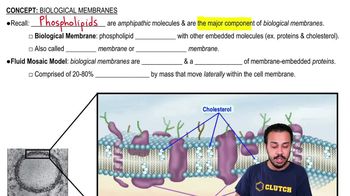
The formation of cell membranes is a critical step in the origin of life, as it allows for the compartmentalization of biochemical processes. Membranes are primarily composed of phospholipids, which spontaneously form bilayers in aqueous environments. This property is fundamental to the development of early cellular structures, enabling the separation of internal and external environments, which is essential for maintaining homeostasis and facilitating metabolic reactions.
Recommended video:
Guided course
06:04
Biological Membranes