Pearson+ LogoPearson+ Logo
Ch. 1 Biology: The Study of Scientific Life
Taylor - Campbell Biology: Concepts & Connections 10th Edition
Taylor, Simon, Dickey, Hogan10th EditionCampbell Biology: Concepts & ConnectionsISBN: 9780136538783Not the one you use?Change textbook
Chapter 1, Problem 12

Describe the process of scientific inquiry and explain why it is not a rigid method.

Verified step by step guidance
1
Scientific inquiry begins with making observations about the natural world. These observations can be qualitative (descriptive) or quantitative (numerical). Scientists use these observations to identify patterns or phenomena that require further investigation.
The next step is to formulate a testable hypothesis. A hypothesis is a tentative explanation for the observed phenomena, stated in a way that it can be tested through experimentation or further observation.
Design and conduct experiments or gather data to test the hypothesis. This involves identifying variables (independent, dependent, and controlled) and ensuring the experiment is repeatable and unbiased. Data collection methods may vary depending on the field of study.
Analyze the data collected during the experiment. This step often involves statistical analysis to determine whether the results support or refute the hypothesis. Scientists look for trends, correlations, or significant differences in the data.
Scientific inquiry is not a rigid method because it is iterative and adaptable. If the hypothesis is not supported, scientists revise it or develop new hypotheses. Additionally, unexpected results can lead to new questions and areas of study, demonstrating the dynamic and flexible nature of the scientific process.

Verified video answer for a similar problem:

This video solution was recommended by our tutors as helpful for the problem above.
Video duration:
3m
Was this helpful?

Key Concepts

Here are the essential concepts you must grasp in order to answer the question correctly.

Scientific Inquiry

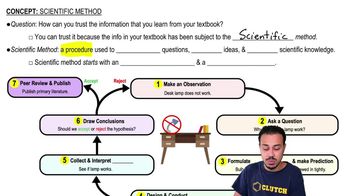
Scientific inquiry is a systematic process used by scientists to explore observations, answer questions, and test hypotheses. It involves making observations, forming questions, developing hypotheses, conducting experiments, and analyzing data. This iterative process allows for adjustments and refinements based on findings, leading to a deeper understanding of natural phenomena.
Recommended video:
Guided course
06:29
Scientific Method

Hypothesis Testing

Hypothesis testing is a fundamental aspect of scientific inquiry where researchers propose explanations for observed phenomena and then test these explanations through experimentation. A hypothesis is a testable prediction that can be supported or refuted by empirical evidence. This process is crucial for validating scientific theories and ensuring that conclusions are based on reliable data.
Recommended video:

Flexibility in Scientific Methods

Scientific inquiry is not a rigid method because it allows for flexibility and adaptation based on new evidence and insights. Scientists may revise their hypotheses, change experimental designs, or explore alternative explanations as they gather more data. This dynamic nature of scientific inquiry fosters creativity and innovation, enabling researchers to respond to unexpected results and refine their understanding of complex systems.
Recommended video:
Guided course
06:29
Scientific Method