Pearson+ LogoPearson+ Logo
Ch. 1 Biology: The Study of Scientific Life
Taylor - Campbell Biology: Concepts & Connections 10th Edition
Taylor, Simon, Dickey, Hogan10th EditionCampbell Biology: Concepts & ConnectionsISBN: 9780136538783Not the one you use?Change textbook
Chapter 1, Problem 11

Explain the role of heritable variations in Darwin's theory of natural selection.

Verified step by step guidance
1
Understand that heritable variations refer to differences in traits that are passed from parents to offspring through genetic material (DNA). These variations arise due to mutations, genetic recombination, and other processes.
Recognize that in Darwin's theory of natural selection, heritable variations are crucial because they provide the raw material for evolution. Without variation, there would be no differences for natural selection to act upon.
Explain that some heritable variations may confer advantages to individuals in a specific environment, such as better camouflage, faster movement, or resistance to disease. These advantageous traits increase the likelihood of survival and reproduction.
Describe how individuals with advantageous traits are more likely to pass these traits to their offspring, leading to an increase in the frequency of these traits in the population over generations. This process is known as 'differential reproductive success.'
Conclude by emphasizing that heritable variations are essential for the adaptation of populations to changing environments, driving the process of evolution through natural selection as described by Darwin.

Verified video answer for a similar problem:

This video solution was recommended by our tutors as helpful for the problem above.
Video duration:
1m
Was this helpful?

Key Concepts

Here are the essential concepts you must grasp in order to answer the question correctly.

Heritable Variations

Heritable variations refer to the genetic differences among individuals in a population that can be passed from one generation to the next. These variations arise from mutations, gene shuffling during reproduction, and other genetic processes. They are crucial for evolution, as they provide the raw material upon which natural selection can act.
Recommended video:
02:16
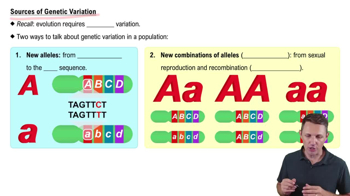
Sources of Genetic Variation

Natural Selection

Natural selection is a mechanism of evolution proposed by Charles Darwin, where individuals with advantageous traits are more likely to survive and reproduce. Over time, these traits become more common in the population, leading to evolutionary change. Natural selection acts on heritable variations, favoring those that enhance survival and reproductive success.
Recommended video:
04:43
Natural Selection

Adaptation

Adaptation is the process by which a species becomes better suited to its environment through the accumulation of beneficial heritable traits. These adaptations arise from natural selection acting on heritable variations, allowing organisms to thrive in specific ecological niches. Over generations, adaptations can lead to significant changes in a population's characteristics.
Recommended video:
05:24
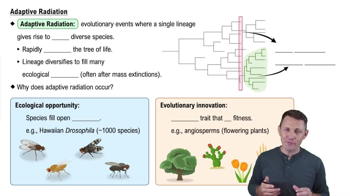
Adaptive Radiation