
Pearson+ LogoPearson+ Logo
Ch. 1 Biology: The Study of Scientific Life
Taylor - Campbell Biology: Concepts & Connections 10th Edition
Taylor, Simon, Dickey, Hogan10th EditionCampbell Biology: Concepts & ConnectionsISBN: 9780136538783Not the one you use?Change textbook
Chapter 1, Problem 9

Which of the following best describes the logic of scientific inquiry?
a. If I generate a testable hypothesis, my experiments will support it.
b. If my prediction is correct, it will lead to a testable hypothesis.
c. If my observations are accurate, they will support my hypothesis.
d. If my hypothesis is correct, I can expect certain test results.

Verified step by step guidance
1
Understand the scientific method: The scientific method is a systematic process used to explore observations, answer questions, and test hypotheses. It involves making observations, forming a hypothesis, making predictions, conducting experiments, and analyzing results.
Define a hypothesis: A hypothesis is a testable and falsifiable statement that provides a possible explanation for a phenomenon. It is often written in an 'if-then' format, where the 'if' part describes the hypothesis and the 'then' part describes the expected outcome.
Recognize the role of predictions: Predictions are specific outcomes that are expected if the hypothesis is correct. These predictions are tested through experiments or further observations.
Understand the relationship between hypothesis and test results: If a hypothesis is correct, the test results should align with the predictions made. This does not guarantee the hypothesis is true but provides support for it. Conversely, if the results do not align, the hypothesis may need to be revised or rejected.
Evaluate the options: Based on the above understanding, analyze each option to determine which one best aligns with the logic of scientific inquiry. The correct answer will reflect the expectation of certain test results if the hypothesis is correct.

Verified video answer for a similar problem:

This video solution was recommended by our tutors as helpful for the problem above.
Video duration:
56s
Was this helpful?

Key Concepts

Here are the essential concepts you must grasp in order to answer the question correctly.

Hypothesis Testing

Hypothesis testing is a fundamental aspect of scientific inquiry where researchers formulate a testable statement based on observations. This hypothesis is then subjected to experimentation to determine its validity. The process involves predicting outcomes that can be measured and analyzed, allowing scientists to draw conclusions about the relationship between variables.
Recommended video:

Predictive Validity

Predictive validity refers to the extent to which a hypothesis can accurately forecast the results of future experiments. A strong hypothesis should lead to specific predictions that can be tested. If the predictions hold true under experimental conditions, it supports the hypothesis, reinforcing its credibility within the scientific framework.
Recommended video:
Guided course
08:22
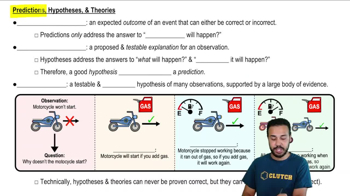
Predictions, Hypotheses, & Theories

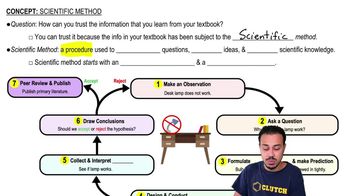
Scientific Method

The scientific method is a systematic approach to inquiry that involves making observations, forming hypotheses, conducting experiments, and analyzing data. This iterative process allows scientists to refine their hypotheses based on experimental results. It emphasizes the importance of empirical evidence and reproducibility in validating scientific claims.
Recommended video:
Guided course
06:29
Scientific Method