Pearson+ LogoPearson+ Logo
Ch. 1 Biology: The Study of Scientific Life
Taylor - Campbell Biology: Concepts & Connections 10th Edition
Taylor, Simon, Dickey, Hogan10th EditionCampbell Biology: Concepts & ConnectionsISBN: 9780136538783Not the one you use?Change textbook
Chapter 1, Problem 4

Which of the following statements best distinguishes hypotheses from theories in science?
a. Theories are hypotheses that have been proven.
b. Hypotheses usually are narrow in scope; theories have broad explanatory power.
c. Hypotheses are tentative guesses; theories are correct answers to questions about nature.
d. Hypotheses and theories are different terms for essentially the same thing in science.

Verified step by step guidance
1
Step 1: Begin by understanding the definitions of both hypotheses and theories in science. A hypothesis is a tentative explanation or prediction that can be tested through experiments and observations. It is often narrow in scope and focuses on specific phenomena.
Step 2: Contrast this with a scientific theory, which is a well-substantiated explanation of some aspect of the natural world. Theories are broader in scope and are supported by a large body of evidence gathered from multiple experiments and observations over time.
Step 3: Evaluate the options provided in the question. Option (a) incorrectly states that theories are hypotheses that have been proven, which is not accurate because theories are not 'proven' but are supported by evidence. Option (c) incorrectly suggests that theories are 'correct answers,' which oversimplifies the nature of scientific theories.
Step 4: Consider option (d), which claims that hypotheses and theories are essentially the same thing. This is incorrect because hypotheses and theories serve different roles in the scientific process.
Step 5: Recognize that option (b) correctly distinguishes hypotheses from theories by stating that hypotheses are narrow in scope, while theories have broad explanatory power. This aligns with the definitions and roles of these concepts in science.

Verified video answer for a similar problem:

This video solution was recommended by our tutors as helpful for the problem above.
Video duration:
2m
Was this helpful?

Key Concepts

Here are the essential concepts you must grasp in order to answer the question correctly.

Hypothesis

A hypothesis is a specific, testable prediction about the relationship between two or more variables. It is often formulated based on prior knowledge or observations and serves as a starting point for scientific investigation. Hypotheses are typically narrow in scope, focusing on particular aspects of a phenomenon, and can be supported or refuted through experimentation.
Recommended video:
Guided course
08:22
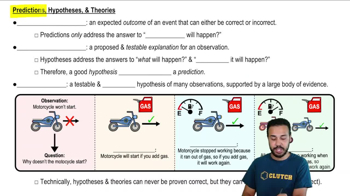
Predictions, Hypotheses, & Theories

Theory

A theory is a well-substantiated explanation of an aspect of the natural world that is based on a body of evidence and has withstood repeated testing and scrutiny. Theories are broader in scope than hypotheses and can encompass multiple hypotheses, providing a comprehensive framework for understanding complex phenomena. They are not merely guesses but are grounded in extensive research and observation.
Recommended video:
Guided course
06:58
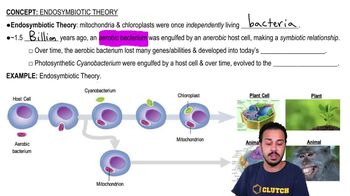
Endosymbiotic Theory

Distinction between Hypotheses and Theories

The distinction between hypotheses and theories lies in their scope and level of validation. While hypotheses are tentative and specific predictions awaiting testing, theories are established explanations that integrate and summarize a wide range of evidence. Understanding this difference is crucial for interpreting scientific statements and recognizing the evolving nature of scientific knowledge.
Recommended video:
Guided course
08:22
Predictions, Hypotheses, & Theories