Pearson+ LogoPearson+ Logo
Ch. 1 Biology: The Study of Scientific Life
Taylor - Campbell Biology: Concepts & Connections 10th Edition
Taylor, Simon, Dickey, Hogan10th EditionCampbell Biology: Concepts & ConnectionsISBN: 9780136538783Not the one you use?Change textbook
Chapter 1, Problem 5

Which of the following best demonstrates the unity among all living organisms?
a. Structure correlated with function
b. DNA and a common genetic code
c. Emergent properties
d. Natural selection

Verified step by step guidance
1
Understand the concept of 'unity among all living organisms,' which refers to the shared characteristics that connect all forms of life despite their diversity.
Review the options provided: (a) structure correlated with function, (b) DNA and a common genetic code, (c) emergent properties, and (d) natural selection.
Analyze option (a): 'Structure correlated with function' refers to how biological structures are designed to perform specific functions, but this concept does not directly highlight the unity among all living organisms.
Analyze option (b): 'DNA and a common genetic code' is a fundamental feature shared by all living organisms, as the genetic code is universal and used by all life forms to store and transmit genetic information.
Compare the remaining options (c and d): 'Emergent properties' describe how complex systems arise from simpler components, and 'natural selection' explains the mechanism of evolution, but neither directly demonstrates the unity among all living organisms as clearly as the shared genetic code in option (b).

Verified video answer for a similar problem:

This video solution was recommended by our tutors as helpful for the problem above.
Video duration:
1m
Was this helpful?

Key Concepts

Here are the essential concepts you must grasp in order to answer the question correctly.

Unity of Life

The unity of life refers to the shared characteristics and common ancestry of all living organisms. Despite the vast diversity in form and function, all life on Earth shares fundamental biological processes and structures, indicating a common origin. This concept underscores the interconnectedness of life and is foundational in understanding evolutionary biology.
Recommended video:
Guided course
09:26
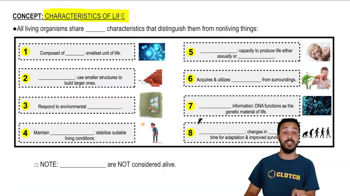
Characteristics of Life

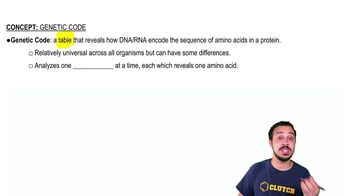
DNA and Genetic Code

DNA (deoxyribonucleic acid) is the hereditary material in all living organisms, containing the instructions for development, functioning, growth, and reproduction. The universal genetic code, which dictates how sequences of nucleotides in DNA are translated into proteins, is remarkably consistent across different species. This commonality in genetic coding is a key piece of evidence for the unity of life.
Recommended video:

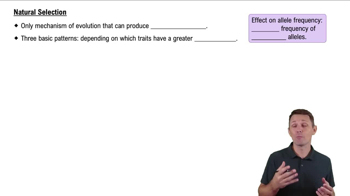
Natural Selection

Natural selection is a mechanism of evolution proposed by Charles Darwin, where organisms better adapted to their environment tend to survive and reproduce more successfully. This process leads to the gradual evolution of species and highlights the diversity of life. However, it also emphasizes the shared ancestry of organisms, as all species evolve from common ancestors through this process.
Recommended video:
04:43
Natural Selection
Related Practice
Textbook Question

All the organisms on your campus make up

a. An ecosystem

b. A community

c. A population

d. The biosphere

1124
views
Textbook Question

Which of these is not a property of all living organisms?

a. Capable of reproduction

b. Uses energy

c. Composed of multiple cells

d. Responds to the environment

2366
views
1
rank
Textbook Question

Which of the following statements best distinguishes hypotheses from theories in science?

a. Theories are hypotheses that have been proven.

b. Hypotheses usually are narrow in scope; theories have broad explanatory power.

c. Hypotheses are tentative guesses; theories are correct answers to questions about nature.

d. Hypotheses and theories are different terms for essentially the same thing in science.

1256
views
Textbook Question

A controlled experiment is one that

a. Proceeds slowly enough that a scientist can make careful records of the results.

b. Keeps all variables constant.

c. Is repeated many times to make sure the results are accurate.

d. Tests experimental and control groups in parallel.

1948
views
Textbook Question

Which of the following is a true statement of observational data?

a. It is always qualitative, not quantitative.

b. It is used to form hypotheses, but not to test them.

c. It can include comparisons of fossils as well as DNA sequences.

d. It is the type of data used for the independent variable in a controlled experiment.

1256
views
Textbook Question

A biologist studying interactions among the bacteria in an ecosystem could not be working at which level in life's hierarchy? (Choose carefully and explain your answer.)

a. The population level

b. The molecular level

c. The organism level

d. The organ level

1580
views