Pearson+ LogoPearson+ Logo
Ch. 1 Biology: The Study of Scientific Life
Taylor - Campbell Biology: Concepts & Connections 10th Edition
Taylor, Simon, Dickey, Hogan10th EditionCampbell Biology: Concepts & ConnectionsISBN: 9780136538783Not the one you use?Change textbook
Chapter 1, Problem 6

A controlled experiment is one that
a. Proceeds slowly enough that a scientist can make careful records of the results.
b. Keeps all variables constant.
c. Is repeated many times to make sure the results are accurate.
d. Tests experimental and control groups in parallel.

Verified step by step guidance
1
Understand the definition of a controlled experiment: A controlled experiment is a scientific test where the researcher manipulates one variable (independent variable) while keeping all other variables constant to observe its effect on the dependent variable.
Identify the key components of a controlled experiment: It involves an experimental group (where the independent variable is altered) and a control group (where the independent variable is not altered). These groups are tested in parallel to compare results.
Analyze the options provided in the question: Option (a) refers to the speed of the experiment, which is not a defining feature of a controlled experiment. Option (b) suggests keeping all variables constant, which is incorrect because the independent variable is intentionally changed. Option (c) refers to repetition for accuracy, which is a good practice but not specific to controlled experiments. Option (d) correctly describes the parallel testing of experimental and control groups.
Eliminate incorrect options based on the analysis: Options (a), (b), and (c) do not align with the definition of a controlled experiment, leaving option (d) as the correct choice.
Conclude that the correct answer is option (d), as it accurately describes the testing of experimental and control groups in parallel, which is a hallmark of a controlled experiment.

Verified video answer for a similar problem:

This video solution was recommended by our tutors as helpful for the problem above.
Video duration:
1m
Was this helpful?

Key Concepts

Here are the essential concepts you must grasp in order to answer the question correctly.

Controlled Experiment

A controlled experiment is a scientific test that aims to isolate the effect of a single variable by keeping all other variables constant. This allows researchers to determine the causal relationship between the independent variable (the one being tested) and the dependent variable (the one being measured). By controlling extraneous factors, scientists can draw more reliable conclusions from their data.
Recommended video:
Guided course
08:56
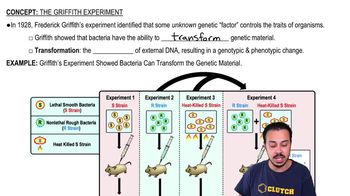
The Griffith Experiment

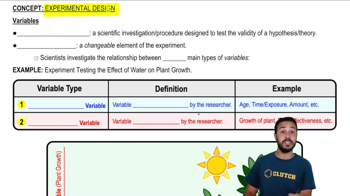
Variables in Experiments

In the context of experiments, variables are elements that can change or be manipulated. The independent variable is the factor that is altered to observe its effect, while the dependent variable is the outcome that is measured. Control variables are those that are kept constant to ensure that any changes in the dependent variable are solely due to the manipulation of the independent variable.
Recommended video:

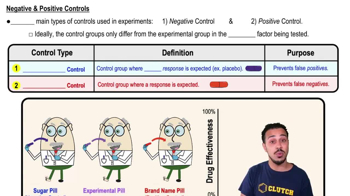
Experimental and Control Groups

In a controlled experiment, the experimental group receives the treatment or condition being tested, while the control group does not. This comparison allows researchers to assess the effect of the independent variable by observing differences in outcomes between the two groups. Testing both groups in parallel ensures that results are not influenced by external factors, enhancing the validity of the findings.
Recommended video:
Guided course
07:42
Negative & Positive Controls
Related Practice
Textbook Question

Which of these is not a property of all living organisms?

a. Capable of reproduction

b. Uses energy

c. Composed of multiple cells

d. Responds to the environment

2366
views
1
rank
Textbook Question

Which of the following statements best distinguishes hypotheses from theories in science?

a. Theories are hypotheses that have been proven.

b. Hypotheses usually are narrow in scope; theories have broad explanatory power.

c. Hypotheses are tentative guesses; theories are correct answers to questions about nature.

d. Hypotheses and theories are different terms for essentially the same thing in science.

1256
views
Textbook Question

Which of the following best demonstrates the unity among all living organisms?

a. Structure correlated with function

b. DNA and a common genetic code

c. Emergent properties

d. Natural selection

1136
views
Textbook Question

Which of the following is a true statement of observational data?

a. It is always qualitative, not quantitative.

b. It is used to form hypotheses, but not to test them.

c. It can include comparisons of fossils as well as DNA sequences.

d. It is the type of data used for the independent variable in a controlled experiment.

1256
views
Textbook Question

A biologist studying interactions among the bacteria in an ecosystem could not be working at which level in life's hierarchy? (Choose carefully and explain your answer.)

a. The population level

b. The molecular level

c. The organism level

d. The organ level

1580
views
Textbook Question

Which of the following best describes the logic of scientific inquiry?

a. If I generate a testable hypothesis, my experiments will support it.

b. If my prediction is correct, it will lead to a testable hypothesis.

c. If my observations are accurate, they will support my hypothesis.

d. If my hypothesis is correct, I can expect certain test results.

1291
views