Pearson+ LogoPearson+ Logo
Ch. 22 Gas Exchange
Taylor - Campbell Biology: Concepts & Connections 10th Edition
Taylor, Simon, Dickey, Hogan10th EditionCampbell Biology: Concepts & ConnectionsISBN: 9780136538783Not the one you use?Change textbook
Chapter 22, Problem 1

Complete the following concept map to review some of the concepts of gas exchange.
Concept map illustrating gas exchange in the circulatory system for biology course.

Verified step by step guidance
1
Step 1: Identify the requirements for gas exchange. Gas exchange requires a moist, thin surface (a) to facilitate the exchange of gases like oxygen (O₂) and carbon dioxide (CO₂). Oxygen is needed for cellular respiration, while carbon dioxide is a waste product of this process.
Step 2: Recognize the role of transport mechanisms. Gas exchange often relies on (b) the circulatory system to transport gases between the lungs and tissue cells (c).
Step 3: Understand the role of red blood cells. Red blood cells contain (d) hemoglobin, a protein that binds and transports oxygen and helps to buffer the blood by transporting CO₂ (g).
Step 4: Explore ventilation in mammals. Mammals ventilate by (f) breathing, which is regulated by breathing control centers in the brain. This ensures the continuous exchange of gases.
Step 5: Connect the concepts. The process of gas exchange integrates the roles of the respiratory system, circulatory system, and cellular respiration to maintain homeostasis and support life functions.

Verified video answer for a similar problem:

This video solution was recommended by our tutors as helpful for the problem above.
Video duration:
1m
Was this helpful?

Key Concepts

Here are the essential concepts you must grasp in order to answer the question correctly.

Gas Exchange

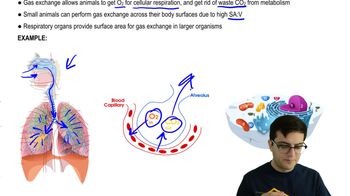
Gas exchange is the biological process through which organisms exchange oxygen (O2) and carbon dioxide (CO2) with their environment. This process is essential for cellular respiration, where O2 is utilized for energy production, and CO2 is expelled as a waste product. Effective gas exchange requires a moist and thin membrane to facilitate the diffusion of gases.
Recommended video:
Guided course
05:55
Gas Exchange and Breathing

Role of Red Blood Cells

Red blood cells (RBCs) play a crucial role in gas exchange by transporting O2 from the lungs to tissues and carrying CO2 from tissues back to the lungs. They contain hemoglobin, a protein that binds to O2 and CO2, enhancing the efficiency of gas transport in the circulatory system. This binding is vital for maintaining proper oxygen levels in tissues and removing metabolic waste.
Recommended video:
Guided course
07:01
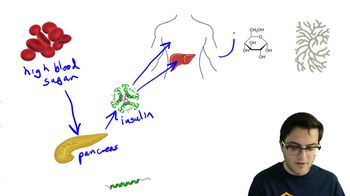
Blood Sugar Homeostasis

Breathing Control Centers

Breathing control centers, located in the brainstem, regulate the rate and depth of breathing based on the body's oxygen and carbon dioxide levels. These centers respond to changes in blood chemistry, ensuring that gas exchange meets the metabolic demands of the body. Proper functioning of these centers is essential for maintaining homeostasis and efficient gas exchange.
Recommended video:
Guided course
05:55
Gas Exchange and Breathing