Pearson+ LogoPearson+ Logo
Ch. 22 Gas Exchange
Taylor - Campbell Biology: Concepts & Connections 10th Edition
Taylor, Simon, Dickey, Hogan10th EditionCampbell Biology: Concepts & ConnectionsISBN: 9780136538783Not the one you use?Change textbook
Chapter 22, Problem 4

Countercurrent gas exchange in the gills of a fish
a. Maintains a gradient that enhances diffusion.
b. Enables the fish to obtain oxygen without swimming.
c. Means that blood and water flow at different rates.
d. Allows O2 to diffuse against its partial pressure gradient.

Verified step by step guidance
1
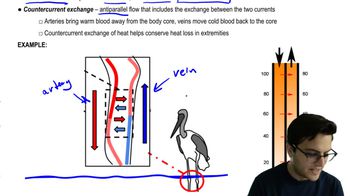
Understand the concept of countercurrent gas exchange: This is a mechanism in which blood and water flow in opposite directions across the gills of a fish. This arrangement maximizes the efficiency of oxygen diffusion from water into the blood.
Recall the principle of diffusion: Oxygen moves from an area of higher partial pressure to an area of lower partial pressure. In countercurrent exchange, the gradient for oxygen diffusion is maintained along the entire length of the gill lamellae.
Analyze the options: Option (a) suggests that countercurrent exchange maintains a gradient that enhances diffusion. This aligns with the mechanism of countercurrent exchange, as the gradient is preserved due to the opposite flow of water and blood.
Evaluate the other options: Option (b) is incorrect because countercurrent exchange does not depend on whether the fish is swimming or stationary. Option (c) is incorrect because the mechanism does not involve different flow rates but rather opposite flow directions. Option (d) is incorrect because oxygen diffusion occurs along the partial pressure gradient, not against it.
Conclude that the correct answer is the option that aligns with the mechanism of countercurrent gas exchange, which is maintaining a gradient that enhances diffusion.

Verified video answer for a similar problem:

This video solution was recommended by our tutors as helpful for the problem above.
Video duration:
1m
Was this helpful?

Key Concepts

Here are the essential concepts you must grasp in order to answer the question correctly.

Countercurrent Exchange Mechanism

The countercurrent exchange mechanism is a biological process where two fluids flow in opposite directions, maximizing the transfer of substances between them. In fish gills, this mechanism allows oxygen-rich water to flow past oxygen-poor blood, maintaining a concentration gradient that enhances the diffusion of oxygen into the blood.
Recommended video:
Guided course
06:28
Countercurrent Exchange

Diffusion and Partial Pressure

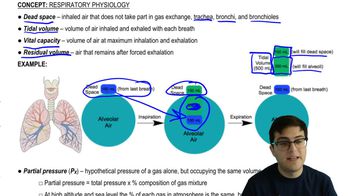
Diffusion is the movement of molecules from an area of higher concentration to an area of lower concentration. In the context of gas exchange, oxygen moves from water (where its partial pressure is higher) into the blood (where its partial pressure is lower), allowing fish to efficiently extract oxygen even when the water's oxygen levels are low.
Recommended video:
Guided course
08:52
Air Movement and Partial Pressure

Gill Structure and Function

Fish gills are specialized organs designed for gas exchange, consisting of thin filaments and lamellae that increase surface area. This structure facilitates the efficient transfer of oxygen and carbon dioxide between the water and the blood, enabling fish to breathe effectively while submerged.
Recommended video:
Guided course
06:04
Functional Groups