Pearson+ LogoPearson+ Logo
Ch. 22 Gas Exchange
Taylor - Campbell Biology: Concepts & Connections 10th Edition
Taylor, Simon, Dickey, Hogan10th EditionCampbell Biology: Concepts & ConnectionsISBN: 9780136538783Not the one you use?Change textbook
Chapter 22, Problem 2

Label the parts of the human respiratory system.
<Image>

Verified step by step guidance
1
Identify part 'a' as the nasal cavity, which is the primary entry point for air into the respiratory system.
Label part 'b' as the pharynx, a muscular tube that serves as a pathway for air from the nasal cavity to the larynx.
Label part 'c' as the larynx, also known as the voice box, which is involved in sound production and directs air into the trachea.
Label part 'd' as the trachea, a tube reinforced with cartilage rings that transports air from the larynx to the bronchi.
Label parts 'e', 'f', 'g', and 'h' as components of the lungs: 'e' is the bronchi, 'f' is the heart (not part of the respiratory system but visible in the image), 'g' is the alveoli where gas exchange occurs, and 'h' is the diaphragm, a muscle that aids in breathing by contracting and relaxing.

Verified video answer for a similar problem:

This video solution was recommended by our tutors as helpful for the problem above.
Video duration:
1m
Was this helpful?

Key Concepts

Here are the essential concepts you must grasp in order to answer the question correctly.

Anatomy of the Respiratory System

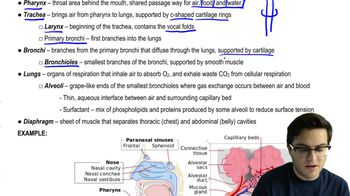
The human respiratory system consists of various structures that facilitate breathing and gas exchange. Key components include the nasal cavity, pharynx, larynx, trachea, bronchi, and lungs. Each part plays a specific role, such as filtering air, producing sound, and allowing oxygen and carbon dioxide exchange.
Recommended video:

Gas Exchange Mechanism

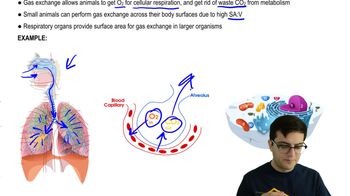
Gas exchange occurs primarily in the alveoli, tiny air sacs in the lungs where oxygen is absorbed into the blood, and carbon dioxide is expelled. This process relies on diffusion, where gases move from areas of higher concentration to lower concentration, ensuring efficient oxygen delivery to tissues and removal of waste gases.
Recommended video:
Guided course
05:55
Gas Exchange and Breathing

Respiratory Cycle

The respiratory cycle consists of two main phases: inhalation and exhalation. Inhalation involves the contraction of the diaphragm and intercostal muscles, expanding the thoracic cavity and drawing air into the lungs. Exhalation is typically passive, where these muscles relax, allowing the lungs to deflate and expel air.
Recommended video: