
Textbook Question
Label the parts of the human respiratory system.
<Image>
3681
views



 Verified step by step guidance
 06:04
06:04
 04:19
04:19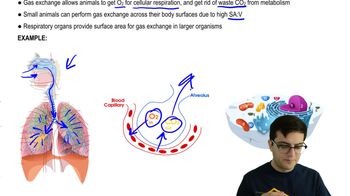 05:55
05:55Label the parts of the human respiratory system.
<Image>
When you hold your breath, which of the following first leads to the urge to breathe?
a. Falling CO2
b. Falling O2
c. Falling pH of the blood
d. Rising pH of the blood
Countercurrent gas exchange in the gills of a fish
a. Maintains a gradient that enhances diffusion.
b. Enables the fish to obtain oxygen without swimming.
c. Means that blood and water flow at different rates.
d. Allows O2 to diffuse against its partial pressure gradient.
In which of the following organisms does oxygen diffuse directly across a respiratory surface to cells, without being carried by the blood?
a. A grasshopper
b. A whale
c. An earthworm
d. A mouse
What is the function of the cilia in the trachea and bronchi?
a. To sweep air into and out of the lungs
b. To increase the surface area for gas exchange
c. To dislodge food that may have slipped past the epiglottis
d. To sweep mucus with trapped particles up and out of the respiratory tract
What do the alveoli of mammalian lungs, the gill filaments of fish, and the tracheal tubes of insects have in common?
a. Use of a circulatory system to transport gases
b. Respiratory surfaces that are infoldings of the body wall
c. Countercurrent exchange
d. A large, moist surface area for gas exchange