Pearson+ LogoPearson+ Logo
Ch. 22 Gas Exchange
Taylor - Campbell Biology: Concepts & Connections 10th Edition
Taylor, Simon, Dickey, Hogan10th EditionCampbell Biology: Concepts & ConnectionsISBN: 9780136538783Not the one you use?Change textbook
Chapter 22, Problem 9

What is the primary feedback used by the brain to control breathing?
a. Heart rate
b. Partial pressure of O2
c. Blood pH, which indicates O2 level
d. Blood pH, which indicates CO2 level

Verified step by step guidance
1
Understand the role of feedback mechanisms in breathing: The brain regulates breathing primarily through feedback mechanisms that monitor the levels of certain gases and pH in the blood.
Recall the relationship between CO2 and blood pH: Carbon dioxide (CO2) dissolves in the blood and reacts with water to form carbonic acid (H2CO3), which dissociates into hydrogen ions (H⁺) and bicarbonate ions (HCO3⁻). This process lowers blood pH, making it more acidic.
Identify the primary feedback signal: The brain, specifically the medulla oblongata, is highly sensitive to changes in blood pH. A drop in pH (indicating an increase in CO2 levels) triggers the brain to increase the rate and depth of breathing to expel more CO2.
Eliminate incorrect options: Heart rate (option a) is not directly used to control breathing. Partial pressure of O2 (option b) is monitored but is a secondary feedback mechanism. Blood pH indicating O2 level (option c) is incorrect because pH changes are primarily linked to CO2 levels, not O2.
Conclude the correct answer: The primary feedback used by the brain to control breathing is blood pH, which indicates CO2 levels (option d).

Verified video answer for a similar problem:

This video solution was recommended by our tutors as helpful for the problem above.
Video duration:
1m
Was this helpful?

Key Concepts

Here are the essential concepts you must grasp in order to answer the question correctly.

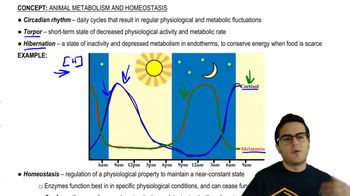
Homeostasis

Homeostasis refers to the body's ability to maintain stable internal conditions despite external changes. In the context of breathing, it involves regulating levels of oxygen (O2) and carbon dioxide (CO2) in the blood to ensure that cellular processes function optimally. The brain monitors these levels to adjust breathing rates accordingly, ensuring that the body meets its metabolic demands.
Recommended video:

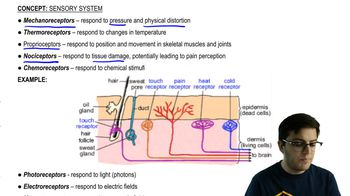
Chemoreceptors

Chemoreceptors are specialized sensory receptors that detect changes in the chemical composition of the blood, particularly the levels of O2 and CO2. These receptors are primarily located in the carotid arteries and the brainstem. They play a crucial role in the respiratory control center of the brain, providing feedback that influences the rate and depth of breathing based on the body's needs.
Recommended video:
Guided course
02:54
Sensory Receptors

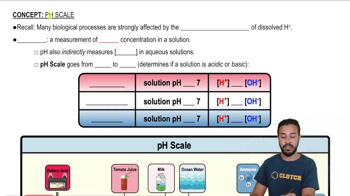
Blood pH and CO2 Levels

Blood pH is a measure of acidity or alkalinity in the blood, which is influenced by the concentration of CO2. When CO2 levels rise, it leads to an increase in carbonic acid, lowering blood pH and signaling the brain to increase breathing rate to expel CO2. This feedback mechanism is vital for maintaining acid-base balance and ensuring proper respiratory function.
Recommended video:
Related Practice
Textbook Question

In which of the following organisms does oxygen diffuse directly across a respiratory surface to cells, without being carried by the blood?

a. A grasshopper

b. A whale

c. An earthworm

d. A mouse

1095
views
Textbook Question

What is the function of the cilia in the trachea and bronchi?

a. To sweep air into and out of the lungs

b. To increase the surface area for gas exchange

c. To dislodge food that may have slipped past the epiglottis

d. To sweep mucus with trapped particles up and out of the respiratory tract

3130
views
Textbook Question

What do the alveoli of mammalian lungs, the gill filaments of fish, and the tracheal tubes of insects have in common?

a. Use of a circulatory system to transport gases

b. Respiratory surfaces that are infoldings of the body wall

c. Countercurrent exchange

d. A large, moist surface area for gas exchange

1572
views
Textbook Question
What are two advantages of breathing air, compared with obtaining dissolved oxygen from water? What is a comparative disadvantage of breathing air?
1850
views
Textbook Question

Trace the path of an oxygen molecule in its journey from the air to a muscle cell in your arm, naming all the structures involved along the way.

6892
views
Textbook Question

Carbon monoxide (CO) is a colorless, odorless gas found in furnace and automobile engine exhaust and cigarette smoke. CO binds to hemoglobin 210 times more tightly than does O2. CO also binds with an electron transport protein and disrupts cellular respiration. Explain why CO is such a deadly gas.

1338
views