
Pearson+ LogoPearson+ Logo
Ch. 22 Gas Exchange
Taylor - Campbell Biology: Concepts & Connections 10th Edition
Taylor, Simon, Dickey, Hogan10th EditionCampbell Biology: Concepts & ConnectionsISBN: 9780136538783Not the one you use?Change textbook
Chapter 22, Problem 7

What is the function of the cilia in the trachea and bronchi?
a. To sweep air into and out of the lungs
b. To increase the surface area for gas exchange
c. To dislodge food that may have slipped past the epiglottis
d. To sweep mucus with trapped particles up and out of the respiratory tract

Verified step by step guidance
1
Understand the structure and location of cilia: Cilia are tiny, hair-like structures found on the surface of certain cells, including those lining the trachea and bronchi in the respiratory system.
Learn the primary function of cilia in the respiratory tract: Cilia work in coordination with mucus-producing cells to trap and remove particles such as dust, pathogens, and other debris from the airways.
Recognize the mechanism of action: The cilia beat in a coordinated, wave-like motion to move the mucus, along with trapped particles, upward toward the throat, where it can be swallowed or expelled.
Eliminate incorrect options: a) Cilia do not directly sweep air into or out of the lungs; this is the function of the diaphragm and intercostal muscles. b) Cilia do not increase surface area for gas exchange; this is the role of alveoli. c) Cilia are not involved in dislodging food; the epiglottis prevents food from entering the trachea.
Conclude the correct answer: The function of cilia in the trachea and bronchi is to sweep mucus with trapped particles up and out of the respiratory tract, which corresponds to option d.

Verified video answer for a similar problem:

This video solution was recommended by our tutors as helpful for the problem above.
Video duration:
1m
Was this helpful?

Key Concepts

Here are the essential concepts you must grasp in order to answer the question correctly.

Cilia Structure and Function

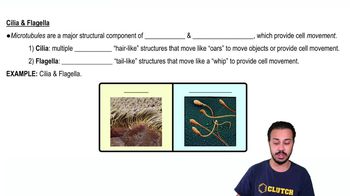
Cilia are microscopic, hair-like structures that line the respiratory tract, including the trachea and bronchi. They play a crucial role in moving mucus and trapped particles out of the airways, helping to keep the respiratory system clear of debris and pathogens. Their coordinated beating creates a wave-like motion that propels mucus upward toward the throat.
Recommended video:
Guided course
03:15
Cilia & Flagella

Mucociliary Escalator

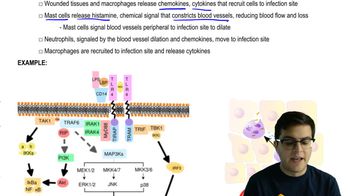
The mucociliary escalator is a defense mechanism of the respiratory system that involves the action of cilia and mucus. Mucus traps inhaled particles and microorganisms, while cilia move this mucus upwards to the pharynx, where it can be swallowed or expelled. This process is vital for maintaining respiratory health and preventing infections.
Recommended video:
Guided course
03:06
Inflammatory Response

Respiratory System Anatomy

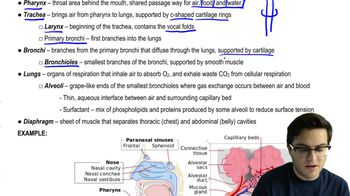
The respiratory system includes structures such as the trachea, bronchi, and lungs, which work together to facilitate gas exchange. The trachea branches into bronchi that lead to the lungs, where oxygen is absorbed and carbon dioxide is expelled. Understanding the anatomy of these structures helps clarify the role of cilia in protecting and maintaining the efficiency of the respiratory system.
Recommended video: