

Pearson+ LogoPearson+ Logo
Ch. 22 Gas Exchange
Taylor - Campbell Biology: Concepts & Connections 10th Edition
Taylor, Simon, Dickey, Hogan10th EditionCampbell Biology: Concepts & ConnectionsISBN: 9780136538783Not the one you use?Change textbook
Chapter 22, Problem 10

What are two advantages of breathing air, compared with obtaining dissolved oxygen from water? What is a comparative disadvantage of breathing air?

Verified step by step guidance
1
Identify the differences in oxygen availability between air and water. Air typically contains a higher concentration of oxygen compared to water, which means organisms that breathe air can take in more oxygen with each breath than those extracting oxygen from water.
Consider the energy efficiency of breathing mechanisms. Breathing air generally requires less energy than the process of extracting oxygen from water, making it more energy-efficient for terrestrial organisms.
Examine the respiratory adaptations in different environments. Organisms adapted to breathe air have evolved efficient respiratory systems, such as lungs, that are highly effective at gas exchange in air-filled environments.
Discuss the limitations of air breathing, such as the necessity of maintaining moist respiratory surfaces. Air-breathing organisms must keep their respiratory surfaces moist to facilitate gas exchange, which can be a challenge in dry environments.
Explore the dependency on specific habitats. Air-breathing organisms are generally limited to terrestrial or aerial habitats, whereas organisms that extract oxygen from water can inhabit a variety of aquatic environments.

Verified video answer for a similar problem:

This video solution was recommended by our tutors as helpful for the problem above.
Video duration:
1m
Was this helpful?

Key Concepts

Here are the essential concepts you must grasp in order to answer the question correctly.

Oxygen Availability

Air contains a higher concentration of oxygen compared to water, making it more efficient for organisms to extract the oxygen they need for cellular respiration. This higher availability allows for greater metabolic rates and energy production, which is crucial for sustaining active lifestyles in terrestrial environments.
Recommended video:
Guided course
07:27
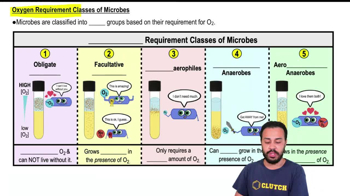
Oxygen Requirement Classes of Microbes

Respiratory Structures

Terrestrial organisms have evolved specialized respiratory structures, such as lungs, that are adapted for extracting oxygen from air. These structures are typically more efficient than gills, which are designed for extracting dissolved oxygen from water, allowing for more effective gas exchange in a gaseous medium.
Recommended video:
Guided course
04:25
Community Structure

Water Loss and Desiccation

Breathing air can lead to increased water loss through evaporation, which is a significant disadvantage for terrestrial organisms. In contrast, aquatic organisms are surrounded by water, reducing the risk of desiccation. This trade-off means that air-breathing animals must have adaptations to conserve water while still meeting their oxygen needs.
Recommended video:
Guided course
01:54
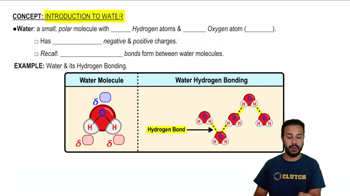
Introduction to Water
Related Practice
Textbook Question

What is the function of the cilia in the trachea and bronchi?

a. To sweep air into and out of the lungs

b. To increase the surface area for gas exchange

c. To dislodge food that may have slipped past the epiglottis

d. To sweep mucus with trapped particles up and out of the respiratory tract

3130
views
Textbook Question

What do the alveoli of mammalian lungs, the gill filaments of fish, and the tracheal tubes of insects have in common?

a. Use of a circulatory system to transport gases

b. Respiratory surfaces that are infoldings of the body wall

c. Countercurrent exchange

d. A large, moist surface area for gas exchange

1572
views
Textbook Question

What is the primary feedback used by the brain to control breathing?

a. Heart rate

b. Partial pressure of O2

c. Blood pH, which indicates O2 level

d. Blood pH, which indicates CO2 level

831
views
Textbook Question

Trace the path of an oxygen molecule in its journey from the air to a muscle cell in your arm, naming all the structures involved along the way.

6892
views
Textbook Question

Carbon monoxide (CO) is a colorless, odorless gas found in furnace and automobile engine exhaust and cigarette smoke. CO binds to hemoglobin 210 times more tightly than does O2. CO also binds with an electron transport protein and disrupts cellular respiration. Explain why CO is such a deadly gas.

1338
views
Textbook Question

Partial pressure reflects the relative amount of gas in a mixture and is measured in millimeters of mercury (mm Hg). Llamas are native to the Andes Mountains in South America. The partial pressure of O2 (abbreviated PO₂) in the atmosphere where llamas live is about half of the PO₂ at sea level. As a result, the PO₂ in the lungs of llamas is about 50 mm Hg, whereas that in human lungs at sea level is about 100 mm Hg. A dissociation curve for hemoglobin shows the percentage of saturation (the amount of O2 bound to hemoglobin) at increasing values of PO₂ As you see in the graph below, the dissociation curves for llama and human hemoglobin differ. Compare these two curves and explain how the hemoglobin of llamas is an adaptation to living where the air is 'thin.'

1767
views