Pearson+ LogoPearson+ Logo
Ch. 13 How Populations Evolve
Taylor - Campbell Biology: Concepts & Connections 10th Edition
Taylor, Simon, Dickey, Hogan10th EditionCampbell Biology: Concepts & ConnectionsISBN: 9780136538783Not the one you use?Change textbook
Chapter 13, Problem 14

Botanists are looking for the wild ancestors of potatoes, corn, and wheat. Why is this search important?

Verified step by step guidance
1
Identify the significance of genetic diversity: Understanding the genetic diversity in wild ancestors can help in identifying genes that might confer resistance to diseases, pests, or environmental stresses.
Explore potential for crop improvement: By studying the wild ancestors, scientists can potentially crossbreed or use genetic engineering to introduce beneficial traits into modern crops, enhancing yield, resilience, and nutritional value.
Understand evolutionary history: Researching wild ancestors helps scientists understand the evolutionary processes and domestication history that led to current crop varieties, providing insights into plant biology and adaptation.
Conserve genetic resources: Identifying and preserving wild ancestors contributes to the conservation of genetic resources, which is crucial for maintaining biodiversity and ensuring sustainable agricultural practices.
Address challenges of climate change: With the ongoing challenges of climate change, having access to a broader genetic pool allows breeders to develop crop varieties that can better withstand new environmental conditions.

Verified video answer for a similar problem:

This video solution was recommended by our tutors as helpful for the problem above.
Video duration:
36s
Was this helpful?

Key Concepts

Here are the essential concepts you must grasp in order to answer the question correctly.

Genetic Diversity

Genetic diversity refers to the variety of genes within a species, which is crucial for adaptation and survival. Wild ancestors of crops often possess unique traits that can enhance disease resistance, drought tolerance, and nutritional value. By studying these wild relatives, botanists can identify beneficial genes that may be lost in cultivated varieties.
Recommended video:
02:37
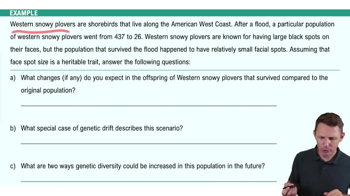
Genetic Drift Example 2

Crop Improvement

Crop improvement involves enhancing the quality and yield of agricultural products through selective breeding and genetic engineering. Understanding the traits of wild ancestors allows scientists to introduce desirable characteristics into modern crops, leading to improved resilience against environmental stresses and pests, ultimately ensuring food security.
Recommended video:
Guided course
02:57
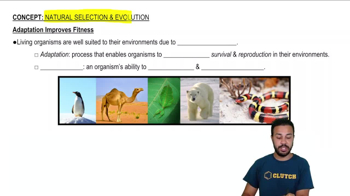
Adaptation Improves Fitness

Conservation of Biodiversity

Conservation of biodiversity is the practice of protecting and preserving the variety of life on Earth, including wild relatives of cultivated plants. This is important not only for ecological balance but also for agriculture, as these wild species can provide essential genetic resources that help sustain crop production in the face of climate change and other challenges.
Recommended video:
Guided course
03:56
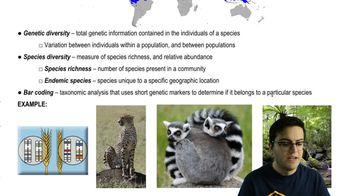
Conservation Biology and Biodiversity
Related Practice
Textbook Question

Sickle-cell disease is caused by a recessive allele. Roughly one out of every 400 African Americans (0.25%) is afflicted with sickle-cell disease. Use the Hardy-Weinberg equation to calculate the percentage of African Americans who are carriers of the sickle-cell allele. (Hint: q2 = 0.0025.)

2125
views
1
rank
Textbook Question
It seems logical that natural selection would work toward genetic uniformity; the genotypes that are most fit produce the most offspring, increasing the frequency of adaptive alleles and eliminating less adaptive alleles. Yet there remains a great deal of genetic variation within populations. Describe factors that contribute to this variation.
1314
views
Textbook Question

Cetaceans are fully aquatic mammals that evolved from terrestrial ancestors. Gather information about the respiratory system of cetaceans and describe how it illustrates the statement made in that 'Evolution is limited by historical constraints.'

946
views
Textbook Question

A population of snails is preyed on by birds that break the snails open on rocks, eat the soft bodies, and leave the shells. The snails occur in both striped and unstriped forms. In one area, researchers counted both live snails and broken shells. Their data are summarized below: Which snail form seems better adapted to this environment? Why? Predict how the frequencies of striped and unstriped snails might change in the future.

1647
views
Textbook Question

Advocates of 'scientific creationism' and 'intelligent design' lobby school districts for such things as a ban on teaching evolution, equal time in science classes to teach alternative versions of the origin and history of life, or disclaimers in textbooks stating that evolution is 'just a theory.' They argue that it is only fair to let students evaluate both evolution and the idea that all species were created by God as the Bible relates or that, because organisms are so complex and well adapted, they must have been created by an intelligent designer. Do you think that alternative views of evolution should be taught in science courses? Why or why not?

780
views