Pearson+ LogoPearson+ Logo
Ch. 13 How Populations Evolve
Taylor - Campbell Biology: Concepts & Connections 10th Edition
Taylor, Simon, Dickey, Hogan10th EditionCampbell Biology: Concepts & ConnectionsISBN: 9780136538783Not the one you use?Change textbook
Chapter 13, Problem 13

It seems logical that natural selection would work toward genetic uniformity; the genotypes that are most fit produce the most offspring, increasing the frequency of adaptive alleles and eliminating less adaptive alleles. Yet there remains a great deal of genetic variation within populations. Describe factors that contribute to this variation.

Verified step by step guidance
1
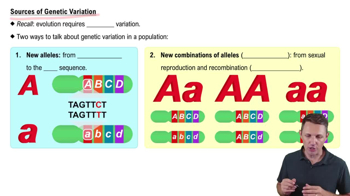
Identify and explain the role of mutations in introducing new genetic variations into a population. Mutations are random changes in the DNA sequence, which can create new alleles and therefore contribute to genetic diversity.
Discuss how sexual reproduction contributes to genetic variation. During sexual reproduction, the combination of genes from two parents during fertilization and processes like crossing over during meiosis introduce new gene combinations into the population.
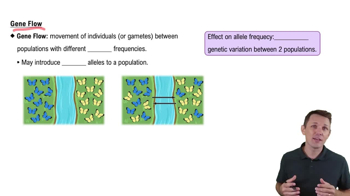
Examine the impact of gene flow on genetic variation. Gene flow involves the movement of alleles between populations through migration of individuals or gametes, which can introduce new alleles to a population and increase its genetic diversity.
Explore the role of genetic drift in changing allele frequencies within a population. Genetic drift is a random process that can cause certain alleles to become more or less common in a population, especially in small populations, thereby contributing to genetic variation.
Consider the effect of natural selection on maintaining or increasing genetic variation. While natural selection can increase the frequency of advantageous alleles, it can also maintain genetic variation through mechanisms like balancing selection, where multiple alleles are preserved in the population.

Verified video answer for a similar problem:

This video solution was recommended by our tutors as helpful for the problem above.
Video duration:
1m
Was this helpful?

Key Concepts

Here are the essential concepts you must grasp in order to answer the question correctly.

Genetic Variation

Genetic variation refers to the differences in DNA sequences among individuals within a population. This variation is crucial for evolution, as it provides the raw material for natural selection to act upon. Factors such as mutations, gene flow, and sexual reproduction contribute to genetic diversity, allowing populations to adapt to changing environments.
Recommended video:
02:16
Sources of Genetic Variation

Natural Selection

Natural selection is a process where individuals with traits better suited to their environment tend to survive and reproduce more than those with less advantageous traits. While it can lead to increased frequency of adaptive alleles, it does not eliminate all genetic variation. Some traits may be neutral or even disadvantageous in certain contexts, allowing for a diverse gene pool.
Recommended video:
04:43
Natural Selection

Gene Flow

Gene flow, or gene migration, is the transfer of genetic material between populations through the movement of individuals or their gametes. This process can introduce new alleles into a population, increasing genetic diversity. It counteracts the effects of natural selection and genetic drift, helping maintain variation even in populations that might otherwise become more uniform.
Recommended video:
01:43
Gene Flow
Related Practice
Textbook Question

Write a paragraph briefly describing the kinds of scientific evidence for evolution.

828
views
Textbook Question

In the early 1800s, French naturalist Jean Baptiste Lamarck suggested that the best explanation for the relationship of fossils to current organisms is that life evolves. He proposed that by using or not using its body parts, an individual may change its traits and then pass those changes on to its offspring. He suggested, for instance, that the ancestors of the giraffe had lengthened their necks by stretching higher and higher into the trees to reach leaves. Evaluate Lamarck's hypotheses from the perspective of present-day scientific knowledge.

1207
views
Textbook Question

Sickle-cell disease is caused by a recessive allele. Roughly one out of every 400 African Americans (0.25%) is afflicted with sickle-cell disease. Use the Hardy-Weinberg equation to calculate the percentage of African Americans who are carriers of the sickle-cell allele. (Hint: q2 = 0.0025.)

2125
views
1
rank
Textbook Question

Cetaceans are fully aquatic mammals that evolved from terrestrial ancestors. Gather information about the respiratory system of cetaceans and describe how it illustrates the statement made in that 'Evolution is limited by historical constraints.'

946
views
Textbook Question
Botanists are looking for the wild ancestors of potatoes, corn, and wheat. Why is this search important?
1005
views
Textbook Question

A population of snails is preyed on by birds that break the snails open on rocks, eat the soft bodies, and leave the shells. The snails occur in both striped and unstriped forms. In one area, researchers counted both live snails and broken shells. Their data are summarized below: Which snail form seems better adapted to this environment? Why? Predict how the frequencies of striped and unstriped snails might change in the future.

1647
views