Pearson+ LogoPearson+ Logo
Ch. 13 How Populations Evolve
Taylor - Campbell Biology: Concepts & Connections 10th Edition
Taylor, Simon, Dickey, Hogan10th EditionCampbell Biology: Concepts & ConnectionsISBN: 9780136538783Not the one you use?Change textbook
Chapter 13, Problem 14

Cetaceans are fully aquatic mammals that evolved from terrestrial ancestors. Gather information about the respiratory system of cetaceans and describe how it illustrates the statement made in that 'Evolution is limited by historical constraints.'

Verified step by step guidance
1
Understand the concept of 'Evolution is limited by historical constraints': This means that evolutionary adaptations are influenced by the traits inherited from ancestors, and organisms cannot completely escape their evolutionary history.
Research the respiratory system of cetaceans: Cetaceans, such as whales and dolphins, are mammals and retain the mammalian trait of breathing air through lungs, despite being fully aquatic.
Identify the evolutionary constraint: Unlike fish, which use gills to extract oxygen from water, cetaceans must surface periodically to breathe air through their blowholes. This limitation arises because their ancestors were terrestrial mammals with lungs, and evolution adapted their existing respiratory system rather than creating a completely new one.
Explain the adaptation: Cetaceans have evolved specialized features to cope with their aquatic lifestyle, such as the ability to hold their breath for extended periods and a blowhole positioned on top of their heads for efficient breathing at the surface. However, they are still constrained by the need to breathe air, illustrating the historical limitation.
Conclude the connection: The respiratory system of cetaceans demonstrates how evolution works with existing structures and traits inherited from ancestors, rather than starting from scratch, which supports the idea that 'Evolution is limited by historical constraints.'

Verified video answer for a similar problem:

This video solution was recommended by our tutors as helpful for the problem above.
Video duration:
1m
Was this helpful?

Key Concepts

Here are the essential concepts you must grasp in order to answer the question correctly.

Cetacean Evolution

Cetaceans, including whales and dolphins, evolved from land-dwelling mammals approximately 50 million years ago. This evolutionary transition involved significant adaptations to an aquatic lifestyle, such as changes in body shape, limb structure, and respiratory systems. Understanding cetacean evolution highlights how historical constraints, such as their ancestry, influence their current biological features.
Recommended video:
05:14
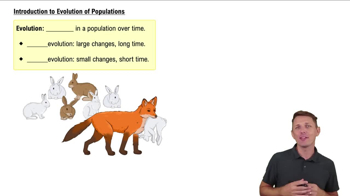
Introduction to Evolution of Populations

Respiratory Adaptations

Cetaceans possess unique respiratory adaptations, including a blowhole located on the top of their heads, allowing them to breathe efficiently at the surface. Their lungs are highly efficient, enabling them to hold their breath for extended periods while diving. These adaptations illustrate how evolutionary changes are shaped by the need to survive in a specific environment, reflecting the limitations imposed by their terrestrial ancestors.
Recommended video:
05:24
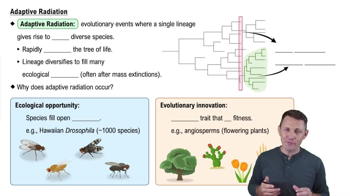
Adaptive Radiation

Historical Constraints in Evolution

Historical constraints refer to the limitations that past evolutionary pathways impose on current organisms. In the case of cetaceans, their evolutionary history as land mammals restricts certain anatomical features, such as the inability to breathe underwater. This concept emphasizes that while evolution can lead to remarkable adaptations, it is also bound by the legacy of ancestral traits, which can limit the range of possible evolutionary outcomes.
Recommended video:
05:14
Introduction to Evolution of Populations
Related Practice
Textbook Question

In the early 1800s, French naturalist Jean Baptiste Lamarck suggested that the best explanation for the relationship of fossils to current organisms is that life evolves. He proposed that by using or not using its body parts, an individual may change its traits and then pass those changes on to its offspring. He suggested, for instance, that the ancestors of the giraffe had lengthened their necks by stretching higher and higher into the trees to reach leaves. Evaluate Lamarck's hypotheses from the perspective of present-day scientific knowledge.

1207
views
Textbook Question

Sickle-cell disease is caused by a recessive allele. Roughly one out of every 400 African Americans (0.25%) is afflicted with sickle-cell disease. Use the Hardy-Weinberg equation to calculate the percentage of African Americans who are carriers of the sickle-cell allele. (Hint: q2 = 0.0025.)

2125
views
1
rank
Textbook Question
It seems logical that natural selection would work toward genetic uniformity; the genotypes that are most fit produce the most offspring, increasing the frequency of adaptive alleles and eliminating less adaptive alleles. Yet there remains a great deal of genetic variation within populations. Describe factors that contribute to this variation.
1314
views
Textbook Question
Botanists are looking for the wild ancestors of potatoes, corn, and wheat. Why is this search important?
1005
views
Textbook Question

A population of snails is preyed on by birds that break the snails open on rocks, eat the soft bodies, and leave the shells. The snails occur in both striped and unstriped forms. In one area, researchers counted both live snails and broken shells. Their data are summarized below: Which snail form seems better adapted to this environment? Why? Predict how the frequencies of striped and unstriped snails might change in the future.

1647
views
Textbook Question

Advocates of 'scientific creationism' and 'intelligent design' lobby school districts for such things as a ban on teaching evolution, equal time in science classes to teach alternative versions of the origin and history of life, or disclaimers in textbooks stating that evolution is 'just a theory.' They argue that it is only fair to let students evaluate both evolution and the idea that all species were created by God as the Bible relates or that, because organisms are so complex and well adapted, they must have been created by an intelligent designer. Do you think that alternative views of evolution should be taught in science courses? Why or why not?

780
views