Pearson+ LogoPearson+ Logo
Ch. 24 The Immune System
Taylor - Campbell Biology: Concepts & Connections 10th Edition
Taylor, Simon, Dickey, Hogan10th EditionCampbell Biology: Concepts & ConnectionsISBN: 9780136538783Not the one you use?Change textbook
Chapter 24, Problem 13

Your roommate is rushed to the hospital after suffering a severe allergic reaction to a bee sting. After she is treated and released, she asks you (the local biology expert!) to explain what happened. She says, 'I don't understand how this could have happened. I've been stung by bees before and didn't have a reaction.' Suggest an explanation for what has happened to cause her severe allergic reaction and why she did not have the reaction after previous bee stings.

Verified step by step guidance
1
Understand that allergic reactions are caused by the immune system responding to a perceived threat. In the case of bee stings, the venom contains proteins that can trigger this response.
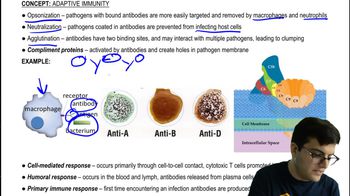
Recognize that sensitization is a key factor. The first time or initial times your roommate was stung by a bee, her immune system was exposed to the venom and began creating specific antibodies (IgE) against the venom proteins.
Explain that upon subsequent exposure to the same allergen (bee venom), these IgE antibodies recognize the venom proteins and bind to them. This binding triggers immune cells called mast cells to release histamine and other chemicals, leading to the symptoms of an allergic reaction.
Discuss how the severity of allergic reactions can vary. It's possible that during previous stings, the immune response was not strong enough to cause noticeable symptoms, but with repeated exposure, the immune system's response can become more aggressive, leading to a severe reaction.
Suggest that individual factors such as changes in health, medication, or even the amount of venom injected can influence the severity of an allergic reaction. It's important for her to consult with a healthcare provider to discuss potential allergies and consider carrying an epinephrine auto-injector in case of future stings.

Verified video answer for a similar problem:

This video solution was recommended by our tutors as helpful for the problem above.
Video duration:
3m
Was this helpful?

Key Concepts

Here are the essential concepts you must grasp in order to answer the question correctly.

Allergic Reactions

An allergic reaction occurs when the immune system overreacts to a substance (allergen) that is typically harmless. In the case of bee stings, the venom contains proteins that can trigger an immune response. This response can range from mild symptoms, like swelling, to severe reactions, such as anaphylaxis, which can be life-threatening.
Recommended video:
Guided course
01:56
Chemical Reactions

Sensitization

Sensitization is the process by which the immune system becomes increasingly reactive to an allergen after initial exposure. In your roommate's case, she may have been stung by bees before without a reaction, but her immune system could have developed sensitivity to bee venom over time, leading to a severe reaction upon subsequent exposure.
Recommended video:

IgE Antibodies

IgE antibodies are a type of immunoglobulin produced by the immune system in response to allergens. When your roommate was first stung, her body may not have produced significant IgE antibodies. However, after repeated exposures, her body could have generated these antibodies, which bind to allergens and trigger the release of histamines and other chemicals, resulting in an allergic reaction.
Recommended video:
Guided course
06:14
Primary and Secondary Immunity
Related Practice
Textbook Question

Which of the following statements is not true?

a. An antibody has more than one antigen-binding site.

b. An antigen can have different epitopes.

c. A lymphocyte has receptors for multiple and different antigens.

d. A bacterium has more than one antigen.

1616
views
Textbook Question
Propose an explanation for why we need a flu shot year after year, instead of only once early in life.
1003
views
Textbook Question

Pertussis (whooping cough) is caused by a bacterial infection, and symptoms include an intense cough that lasts for weeks, sometimes leading to pneumonia and death. A complete vaccination against pertussis requires five doses, completed by age 5. A pertussis outbreak occurred in California in 2010, and a news article reported the following: 'Among fully immunized kids, there were about 36 cases for every 10,000 children two to seven years old, compared to 245 out of every 10,000 kids aged eight to twelve.' Propose an explanation for these data and a public health solution based on your explanation.

1009
views
Textbook Question

Compare the outcomes of two different cases of infectious diseases in a community.

Case 1: A man with an infectious disease enters a community where the disease has not previously occurred.

Case 2: A man with an infectious disease enters a community where almost everyone has been vaccinated against the disease.

900
views
Textbook Question
Organ donation saves many lives each year. Even though some transplanted organs are derived from living donors, the majority come from patients who die but still have healthy organs that can be of value to a transplant recipient. Potential organ donors can fill out an organ donation card to specify their wishes. If the donor is in critical condition and dying, the donor's family is usually consulted to discuss the donation process. Generally, the next of kin must approve before donation can occur, regardless of whether the patient has completed an organ donation card. In some cases, a family member overrides the donor's wishes. Do you think that family members should be able to overrule the stated intentions of the potential donor? Why or why not? Have you signed up to be an organ donor? Why or why not?
810
views
Textbook Question
One of the key difficulties in the development of anti-HIV drugs is the fact that HIV only infects humans. This precludes the testing of drugs in animals and instead requires that drugs be tested on volunteer human subjects. The developing world (particularly sub-Saharan Africa and Southeast Asia) has the highest rates of HIV infection. Consequently, drug companies frequently conduct studies in these regions. Some people decry such tests, fearing that drug companies may profit hugely from the use of economically disadvantaged people. Others counter that such tests are the only way to find new and cheaper drugs that will ultimately help everyone. What do you think are the ethical issues surrounding trials of anti-HIV drugs in the developing world? Which side do you think has the more morally compelling argument?
752
views