The table below lists the common names of the nine animal phyla surveyed in this chapter. For each phylum, list the key characteristics and some representatives.
Ch. 18 The Evolution of Invertebrate Diversity
Taylor, Simon, Dickey, Hogan10th EditionCampbell Biology: Concepts & ConnectionsISBN: 9780136538783Not the one you use?Change textbook
All textbooks
Taylor, Simon, Dickey, Hogan 10th Edition
Ch. 18 The Evolution of Invertebrate Diversity
Problem 3
Taylor, Simon, Dickey, Hogan 10th Edition
Ch. 18 The Evolution of Invertebrate Diversity
Problem 3Chapter 18, Problem 3
Bilateral symmetry in animals is best correlated with
a. An ability to see equally in all directions.
b. The presence of a skeleton.
c. Motility and active predation and escape.
d. Adaptation to terrestrial environments.
Verified step by step guidance1
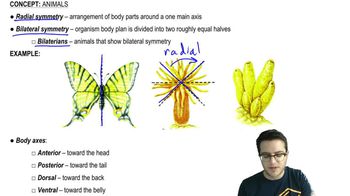
Understand the concept of bilateral symmetry: Bilateral symmetry refers to the arrangement of body parts in such a way that an organism can be divided into two identical halves along a single plane. This is common in animals that have a distinct head and tail region, as well as a left and right side.
Consider the advantages of bilateral symmetry: Animals with bilateral symmetry often have a centralized nervous system and sensory organs concentrated at the front (anterior) end, which aids in directional movement and environmental interaction.
Analyze the options provided: Evaluate each option to determine which one aligns best with the characteristics and advantages of bilateral symmetry. For example, motility and active predation are closely linked to the ability to move efficiently and respond to stimuli, which is facilitated by bilateral symmetry.
Eliminate incorrect options: For instance, the ability to see equally in all directions is more characteristic of radial symmetry, not bilateral symmetry. Similarly, the presence of a skeleton and adaptation to terrestrial environments are not exclusive to bilateral symmetry.
Select the most relevant option: Based on the analysis, identify the option that best correlates with the advantages of bilateral symmetry, such as motility and active predation or escape behaviors.

Verified video answer for a similar problem:
This video solution was recommended by our tutors as helpful for the problem above.
Video duration:
2mWas this helpful?
Key Concepts
Here are the essential concepts you must grasp in order to answer the question correctly.
Bilateral Symmetry
Bilateral symmetry refers to a body plan in which an organism can be divided into two identical halves along a single plane, typically the sagittal plane. This symmetry is common in many animals, including humans, and is associated with a streamlined shape that facilitates movement and orientation in their environment.
Recommended video:
Guided course
Overview of Animals - 4
Motility and Active Predation
Motility is the ability of an organism to move independently and actively in its environment. In animals with bilateral symmetry, this trait often correlates with predatory behaviors, as it allows for directional movement and enhanced sensory perception, aiding in hunting and escaping from predators.
Recommended video:
Guided course
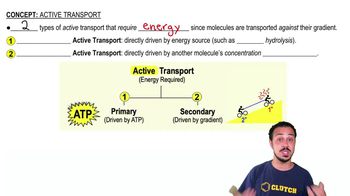
Active Transport
Adaptation to Terrestrial Environments
Adaptation to terrestrial environments involves physiological and structural changes that enable organisms to thrive on land. Bilateral symmetry can facilitate these adaptations by promoting efficient locomotion and sensory processing, which are crucial for survival in diverse terrestrial habitats.
Recommended video:
Guided course
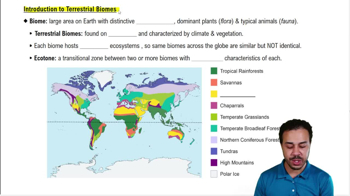
Introduction to Terrestrial Biomes
Related Practice
Textbook Question
1518
views
Textbook Question
Identify the pattern of embryonic development shown in each drawing below and name the phylum (or phyla) that exhibit this pattern.
1259
views
Textbook Question
Jon found an organism in a pond, and he thinks it's a freshwater sponge. His friend Liz thinks it looks more like an aquatic fungus. How can they decide whether it is an animal or a fungus?
a. See if it can swim.
b. Figure out whether it is autotrophic or heterotrophic.
c. See if it is a eukaryote or a prokaryote.
d. Look for cell walls under a microscope.
787
views
Textbook Question
Which of the following groupings includes the largest number of species? (Explain your answer.)
a. Invertebrates
b. Arthropods
c. Insects
d. Vertebrates
1142
views
Textbook Question
Which of the following animal groups does not have tissues derived from mesoderm?
a. Annelids
b. Echinoderms
c. Cnidarians
d. Flatworms
1396
views