Pearson+ LogoPearson+ Logo
Ch. 18 The Evolution of Invertebrate Diversity
Taylor - Campbell Biology: Concepts & Connections 10th Edition
Taylor, Simon, Dickey, Hogan10th EditionCampbell Biology: Concepts & ConnectionsISBN: 9780136538783Not the one you use?Change textbook
Chapter 18, Problem 4

Jon found an organism in a pond, and he thinks it's a freshwater sponge. His friend Liz thinks it looks more like an aquatic fungus. How can they decide whether it is an animal or a fungus?
a. See if it can swim.
b. Figure out whether it is autotrophic or heterotrophic.
c. See if it is a eukaryote or a prokaryote.
d. Look for cell walls under a microscope.

Verified step by step guidance
1
Understand the key differences between animals and fungi. Animals are multicellular, heterotrophic organisms that lack cell walls, while fungi are also heterotrophic but have cell walls made of chitin.
Eliminate irrelevant options. For example, option (a) 'See if it can swim' is not a reliable criterion because not all animals swim, and fungi do not swim either.
Option (b) 'Figure out whether it is autotrophic or heterotrophic' is not helpful here because both animals and fungi are heterotrophic, meaning they obtain their nutrients by consuming organic material.
Option (c) 'See if it is a eukaryote or a prokaryote' is also not useful because both animals and fungi are eukaryotic organisms, meaning their cells have a nucleus and membrane-bound organelles.
Option (d) 'Look for cell walls under a microscope' is the most relevant step. Use a microscope to examine the organism's cells. If the cells have a rigid cell wall, it is likely a fungus. If the cells lack a cell wall, it is likely an animal (such as a freshwater sponge).

Verified video answer for a similar problem:

This video solution was recommended by our tutors as helpful for the problem above.
Video duration:
1m
Was this helpful?

Key Concepts

Here are the essential concepts you must grasp in order to answer the question correctly.

Eukaryotes vs. Prokaryotes

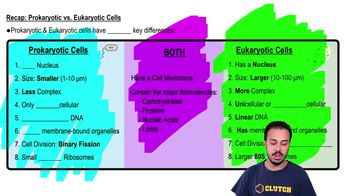
Eukaryotes are organisms whose cells contain a nucleus and other organelles enclosed within membranes, while prokaryotes are unicellular organisms that lack a nucleus. This distinction is fundamental in biology, as it separates complex organisms, including animals and fungi, from simpler forms like bacteria. Identifying whether the organism is a eukaryote can help Jon and Liz determine its classification.
Recommended video:
Guided course
04:26
Recap: Prokaryotic vs. Eukaryotic Cells

Autotrophic vs. Heterotrophic

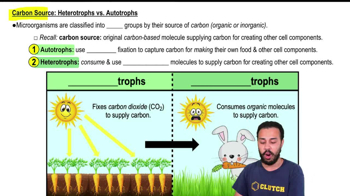
Autotrophic organisms produce their own food through processes like photosynthesis, while heterotrophic organisms obtain their food by consuming other organisms. This concept is crucial for distinguishing between plants (autotrophs) and animals or fungi (heterotrophs). Understanding the nutritional mode of the organism can provide insights into whether it is more likely to be a sponge (animal) or a fungus.
Recommended video:
Guided course
02:59
Carbon Source: Heterotrophs vs. Autotrophs

Cell Walls in Organisms

Cell walls are rigid structures that provide support and protection to cells. In biology, fungi have cell walls made of chitin, while animal cells do not have cell walls at all. Observing the presence or absence of a cell wall under a microscope can help Jon and Liz determine if the organism is more similar to a sponge (animal) or a fungus.
Recommended video:
Guided course
06:52
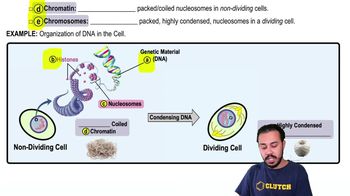
Organization of DNA in the Cell