Pearson+ LogoPearson+ Logo
Ch. 10 Molecular Biology of the Gene
Taylor - Campbell Biology: Concepts & Connections 10th Edition
Taylor, Simon, Dickey, Hogan10th EditionCampbell Biology: Concepts & ConnectionsISBN: 9780136538783Not the one you use?Change textbook
Chapter 10, Problem 6

A geneticist found that a particular mutation had no effect on the polypeptide encoded by a gene. This mutation probably involved
a. Deletion of one nucleotide
b. Alteration of the start codon
c. Insertion of one nucleotide
d. Substitution of one nucleotide

Verified step by step guidance
1
Understand the problem: The question is asking about a mutation that does not affect the polypeptide encoded by a gene. This means the mutation is 'silent' and does not change the amino acid sequence of the resulting protein.
Review the genetic code: The genetic code is redundant, meaning multiple codons can code for the same amino acid. A substitution of one nucleotide in a codon might still result in the same amino acid being incorporated into the polypeptide. This is known as a 'silent mutation.'
Analyze the options: A deletion or insertion of one nucleotide (options a and c) would cause a frameshift mutation, altering the reading frame of the gene and likely changing the entire amino acid sequence downstream of the mutation. This would have a significant effect on the polypeptide.
Consider the start codon (option b): Alteration of the start codon would prevent the ribosome from initiating translation properly, which would have a drastic effect on the polypeptide, likely preventing its synthesis altogether.
Focus on substitution (option d): A substitution of one nucleotide could result in a silent mutation if the new codon still codes for the same amino acid. This is the most likely explanation for a mutation that has no effect on the polypeptide.

Verified video answer for a similar problem:

This video solution was recommended by our tutors as helpful for the problem above.
Video duration:
1m
Was this helpful?

Key Concepts

Here are the essential concepts you must grasp in order to answer the question correctly.

Silent Mutation

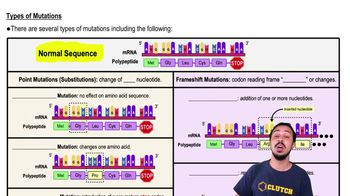
A silent mutation is a change in the DNA sequence that does not alter the amino acid sequence of the resulting polypeptide. This can occur due to the redundancy in the genetic code, where multiple codons can code for the same amino acid. Understanding silent mutations is crucial for interpreting how certain genetic changes can be phenotypically neutral.
Recommended video:
Guided course
08:44
Types of Mutations

Types of Mutations

Mutations can be classified into several types, including substitutions, insertions, and deletions. A substitution involves replacing one nucleotide with another, while insertions and deletions add or remove nucleotides, respectively. The impact of these mutations on protein function varies, with some potentially leading to significant changes, while others may have no effect.
Recommended video:
Guided course
08:44
Types of Mutations

Codon and Amino Acid Relationship

Codons are sequences of three nucleotides in mRNA that correspond to specific amino acids during protein synthesis. The relationship between codons and amino acids is fundamental to understanding how genetic information is translated into functional proteins. Changes in codons can lead to different outcomes, such as silent mutations, missense mutations, or nonsense mutations, depending on the nature of the change.
Recommended video:
Related Practice
Textbook Question
Describe the process of DNA replication: the ingredients needed, the steps in the process, and the final product.
2211
views
1
rank
Textbook Question

What is the name of the process that produces RNA from a DNA template?

What is the name of the process that produces a polypeptide from an RNA template?

1970
views
Textbook Question

Scientists have discovered how to put together a bacteriophage with the protein coat of phage T2 and the DNA of phage lambda. If this composite phage were allowed to infect a bacterium, the phages produced in the host cell would have _________. (Explain your answer.)

a. The protein of T2 and the DNA of lambda

b. The protein of lambda and the DNA of T2

c. The protein and DNA of T2

d. The protein and DNA of lambda

1683
views
Textbook Question
Describe the process by which the information in a eukaryotic gene is transcribed and translated into a protein. Correctly use these words in your description: tRNA, amino acid, start codon, transcription, RNA splicing, exons, introns, mRNA, gene, codon, RNA polymerase, ribosome, translation, anticodon, peptide bond, stop codon.
2002
views
Textbook Question

The nucleotide sequence of a DNA codon is GTA. A messenger RNA molecule with a complementary codon is transcribed from the DNA. In the process of protein synthesis, a transfer RNA pairs with the mRNA codon. What is the nucleotide sequence of the tRNA anticodon?

a. CAT

b. CUT

c. GUA

d. CAU

1798
views
Textbook Question
A cell containing a single chromosome is placed in a medium containing radioactive phosphate so that any new DNA strands formed by DNA replication will be radioactive. The cell replicates its DNA and divides. Then the daughter cells (still in the radioactive medium) replicate their DNA and divide, and a total of four cells are present. Sketch the DNA molecules in all four cells, showing a normal (nonradioactive) DNA strand as a solid line and a radioactive DNA strand as a dashed line.
896
views