Pearson+ LogoPearson+ Logo
Ch. 3 The Molecules of Cells
Taylor - Campbell Biology: Concepts & Connections 10th Edition
Taylor, Simon, Dickey, Hogan10th EditionCampbell Biology: Concepts & ConnectionsISBN: 9780136538783Not the one you use?Change textbook
Chapter 3, Problem 18c

Enzymes usually function best at an optimal pH and temperature. The following graph shows the effectiveness of two enzymes at various temperatures.
From what you know about enzyme structure, explain why the rate of the reaction catalyzed by enzyme A slows down at temperatures above 40°C (140°F).

Verified step by step guidance
1
Understand that enzymes are proteins, and their function is highly dependent on their three-dimensional structure, which is maintained by various types of bonds and interactions (e.g., hydrogen bonds, ionic bonds, and hydrophobic interactions).
Recognize that at higher temperatures, the increased kinetic energy of molecules can disrupt these bonds and interactions, leading to a loss of the enzyme's specific shape, a process known as denaturation.
Explain that denaturation alters the shape of the enzyme's active site, preventing it from binding effectively to its substrate and thus reducing the rate of the catalyzed reaction.
Note that enzyme A likely has an optimal temperature around 40°C, where its structure is stable and its activity is maximized. Beyond this temperature, the destabilization of its structure outweighs any increase in reaction rate due to higher molecular motion.
Conclude that the slowing of the reaction rate above 40°C is due to the enzyme's loss of functional structure, which is critical for its catalytic activity.

Verified video answer for a similar problem:

This video solution was recommended by our tutors as helpful for the problem above.
Video duration:
43s
Was this helpful?

Key Concepts

Here are the essential concepts you must grasp in order to answer the question correctly.

Enzyme Structure and Function

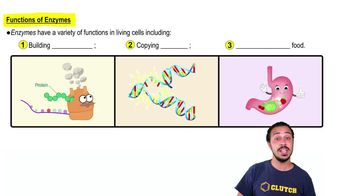
Enzymes are biological catalysts that speed up chemical reactions by lowering the activation energy. Their structure, particularly the active site, is crucial for binding substrates and facilitating reactions. Any alteration in structure can affect their functionality, making it essential to understand how temperature impacts enzyme conformation.
Recommended video:
Guided course
02:32
Functions of Enzymes

Denaturation

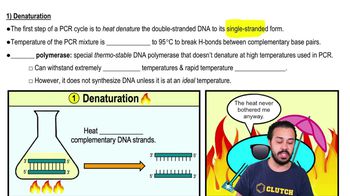
Denaturation refers to the process where an enzyme's three-dimensional structure is altered, often due to extreme conditions such as high temperature or inappropriate pH. This structural change can lead to a loss of enzymatic activity, as the active site may no longer properly bind to the substrate, resulting in a decreased reaction rate.
Recommended video:
Guided course
03:33
1) Denaturation

Optimal Temperature

Each enzyme has an optimal temperature range where it functions most effectively. Beyond this range, particularly at elevated temperatures, the kinetic energy of molecules increases, which can lead to denaturation. Understanding the optimal temperature helps explain why enzyme A's reaction rate decreases at temperatures above 40°C.
Recommended video:
Guided course
05:42
Temperature in Aquatic Biomes