
Pearson+ LogoPearson+ Logo
Ch. 3 The Molecules of Cells
Taylor - Campbell Biology: Concepts & Connections 10th Edition
Taylor, Simon, Dickey, Hogan10th EditionCampbell Biology: Concepts & ConnectionsISBN: 9780136538783Not the one you use?Change textbook
Chapter 3, Problem 18a

Enzymes usually function best at an optimal pH and temperature. The following graph shows the effectiveness of two enzymes at various temperatures.
At which temperature does enzyme A perform best?
At which temperature does Enzyme B?
<IMAGE>

Verified step by step guidance
1
Examine the graph provided. The x-axis represents temperature in degrees Celsius (°C), and the y-axis represents the rate of reaction. The curves for Enzyme A and Enzyme B show how their activity changes with temperature.
Identify the peak of each curve, as this represents the temperature at which each enzyme performs best (optimal temperature). The peak is the highest point on the curve for each enzyme.
For Enzyme A (red curve), locate the temperature at which the curve reaches its maximum height. This is the optimal temperature for Enzyme A.
For Enzyme B (blue curve), locate the temperature at which the curve reaches its maximum height. This is the optimal temperature for Enzyme B.
Conclude that the optimal temperature for each enzyme corresponds to the temperature at the peak of its respective curve, as this is where the rate of reaction is highest.

Verified video answer for a similar problem:

This video solution was recommended by our tutors as helpful for the problem above.
Video duration:
2m
Was this helpful?

Key Concepts

Here are the essential concepts you must grasp in order to answer the question correctly.

Enzyme Activity

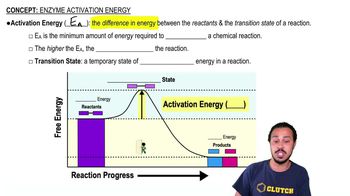
Enzyme activity refers to the rate at which an enzyme catalyzes a reaction. This activity is influenced by various factors, including substrate concentration, pH, and temperature. Each enzyme has an optimal temperature and pH at which it functions most effectively, beyond which its activity may decrease due to denaturation or altered active site conformation.
Recommended video:
Guided course
04:18
Enzyme Activation Energy

Optimal Temperature

The optimal temperature is the specific temperature at which an enzyme exhibits maximum activity. At this temperature, the kinetic energy of the enzyme and substrate molecules is ideal for facilitating the reaction. Deviations from this temperature can lead to reduced enzyme efficiency and, in extreme cases, denaturation, where the enzyme loses its functional shape.
Recommended video:
Guided course
05:42
Temperature in Aquatic Biomes

Graph Interpretation

Graph interpretation involves analyzing visual data representations to extract meaningful information. In the context of enzyme activity, a graph plotting enzyme effectiveness against temperature allows for the identification of trends, such as peaks indicating optimal performance. Understanding how to read such graphs is crucial for determining the best conditions for enzyme function.
Recommended video:
03:54
Interpreting Branch Length
Related Practice
Textbook Question

The diversity of life is staggering. Yet the molecular logic of life is simple and elegant: small molecules common to all organisms are ordered into unique macromolecules. Explain why carbon is central to this diversity of organic molecules.

How do carbon skeletons, chemical groups, monomers, and polymers relate to this molecular logic of life?

1875
views
Textbook Question

How can a cell make many different kinds of proteins out of only 20 amino acids?

Of the myriad possibilities, how does the cell 'know' which proteins to make?

1834
views
Textbook Question

Given that the function of egg yolk is to nourish and support the developing chick, explain why egg yolks are so high in fat, protein, and cholesterol.

2289
views
Textbook Question

Enzymes usually function best at an optimal pH and temperature. The following graph shows the effectiveness of two enzymes at various temperatures. One of these enzymes is found in humans and the other in thermophilic (heat-loving) bacteria.

Which enzyme would you predict comes from which organism?

2043
views
Textbook Question

Enzymes usually function best at an optimal pH and temperature. The following graph shows the effectiveness of two enzymes at various temperatures.

From what you know about enzyme structure, explain why the rate of the reaction catalyzed by enzyme A slows down at temperatures above 40°C (140°F).

1770
views
Textbook Question
Another aspect of the Nurses' Health Study looked at the percentage of change in the risk of coronary heart disease associated with substituting one dietary component for another. These results estimated that replacement of 5% of energy from saturated fat in the diet with unsaturated fats would reduce the risk of heart disease by 42%, and that the replacement of 2% of energy from trans fat with unsaturated fats would reduce the risk by 53%. Explain what these numbers mean.
1300
views