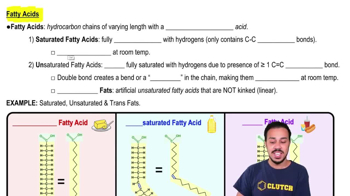
What makes a fatty acid an acid?
a. It does not dissolve in water.
b. It is capable of bonding with other molecules to form a fat.
c. It has a carboxyl group that can donate an H+ to a solution.
d. It contains only two oxygen atoms.
Verified step by step guidance
What makes a fatty acid an acid?
a. It does not dissolve in water.
b. It is capable of bonding with other molecules to form a fat.
c. It has a carboxyl group that can donate an H+ to a solution.
d. It contains only two oxygen atoms.
Cows can derive nutrients from cellulose because
a. They produce enzymes that recognize the shape of the glucose-glucose bonds and hydrolyze them.
b. They re-chew their cud to break down cellulose fibers.
c. Their digestive tract contains microorganisms that can hydrolyze the bonds of cellulose.
d. They convert cellulose to starch and can digest starch.
Of the following functional groups, which is/are polar, tending to make organic compounds hydrophilic?
a. Carbonyl
b. Amino
c. Hydroxyl
d. All of the above
A shortage of phosphorus in the soil would make it especially difficult for a plant to manufacture
a. DNA
b. Proteins
c. Cellulose
d. Sucrose.
Which of the following substances is a major component of the cell membrane of a fungus?
a. Cellulose
b. Chitin
c. Cholesterol
d. Phospholipids
Which structural level of a protein would be least affected by a disruption in hydrogen bonding?
a. Primary structure
b. Secondary structure
c. Tertiary structure
d. Quaternary structure