Pearson+ LogoPearson+ Logo
Ch. 3 The Molecules of Cells
Taylor - Campbell Biology: Concepts & Connections 10th Edition
Taylor, Simon, Dickey, Hogan10th EditionCampbell Biology: Concepts & ConnectionsISBN: 9780136538783Not the one you use?Change textbook
Chapter 3, Problem 8

Which of the following substances is a major component of the cell membrane of a fungus?
a. Cellulose
b. Chitin
c. Cholesterol
d. Phospholipids

Verified step by step guidance
1
Understand the structure and function of fungal cell membranes. Fungal cell membranes are similar to other eukaryotic membranes but have unique components specific to fungi.
Review the role of phospholipids in cell membranes. Phospholipids are the primary structural component of all eukaryotic cell membranes, forming a bilayer that provides fluidity and acts as a barrier.
Consider the role of chitin. Chitin is a polysaccharide found in the cell walls of fungi, not the cell membrane. It provides structural support to the fungal cell wall.
Evaluate the role of cellulose. Cellulose is a polysaccharide found in the cell walls of plants, not fungi, and is not a component of fungal cell membranes.
Assess the role of cholesterol. Cholesterol is found in animal cell membranes, where it helps regulate fluidity, but it is not a major component of fungal cell membranes.

Verified video answer for a similar problem:

This video solution was recommended by our tutors as helpful for the problem above.
Video duration:
1m
Was this helpful?

Key Concepts

Here are the essential concepts you must grasp in order to answer the question correctly.

Cell Membrane Structure

The cell membrane is a biological barrier that surrounds the cell, composed primarily of a phospholipid bilayer. This structure allows for selective permeability, enabling the cell to maintain homeostasis by controlling the movement of substances in and out. In fungi, the composition of the cell membrane differs from that of plants and animals, which is crucial for understanding their unique cellular functions.
Recommended video:
Guided course
09:28
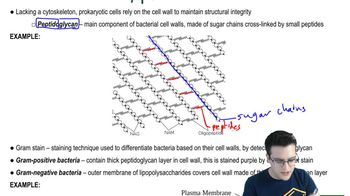
Prokaryotic Cell Structures 1

Chitin

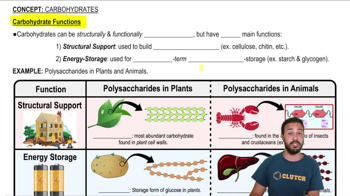
Chitin is a long-chain polymer of N-acetylglucosamine, a derivative of glucose, and serves as a key structural component in the cell walls of fungi. Unlike cellulose in plants, chitin provides rigidity and strength, allowing fungi to maintain their shape and protect against environmental stresses. Understanding chitin's role is essential for recognizing how fungi differ from other organisms in terms of cellular structure.
Recommended video:
Guided course
05:08
Carbohydrate Functions

Phospholipids

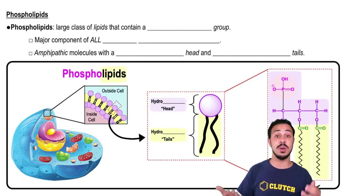
Phospholipids are molecules that form the fundamental building blocks of cell membranes. They consist of a hydrophilic (water-attracting) 'head' and two hydrophobic (water-repelling) 'tails,' which arrange themselves into a bilayer. This arrangement is critical for membrane fluidity and functionality, allowing for the formation of compartments within cells and facilitating communication and transport across the membrane.
Recommended video:
Guided course
04:05
Phospholipids