
Pearson+ LogoPearson+ Logo
Ch. 3 The Molecules of Cells
Taylor - Campbell Biology: Concepts & Connections 10th Edition
Taylor, Simon, Dickey, Hogan10th EditionCampbell Biology: Concepts & ConnectionsISBN: 9780136538783Not the one you use?Change textbook
Chapter 3, Problem 9

Which structural level of a protein would be least affected by a disruption in hydrogen bonding?
a. Primary structure
b. Secondary structure
c. Tertiary structure
d. Quaternary structure

Verified step by step guidance
1
Understand the structural levels of a protein: The primary structure is the sequence of amino acids linked by peptide bonds. The secondary structure involves hydrogen bonding between the backbone of the polypeptide chain, forming alpha-helices and beta-pleated sheets. The tertiary structure is the three-dimensional folding of the protein, stabilized by various interactions, including hydrogen bonds. The quaternary structure involves the assembly of multiple polypeptide chains into a functional protein complex, also stabilized by hydrogen bonds and other interactions.
Identify the role of hydrogen bonding: Hydrogen bonds are critical for stabilizing the secondary, tertiary, and quaternary structures of a protein. However, the primary structure is determined solely by the covalent peptide bonds between amino acids and does not rely on hydrogen bonding.
Analyze the question: The problem asks which structural level would be least affected by a disruption in hydrogen bonding. Since the primary structure does not depend on hydrogen bonds, it would remain unaffected by their disruption.
Compare the other structural levels: The secondary structure (alpha-helices and beta-sheets), tertiary structure (three-dimensional folding), and quaternary structure (multi-subunit assembly) all rely on hydrogen bonding to some extent and would be affected by its disruption.
Conclude the answer: Based on the analysis, the primary structure is the structural level least affected by a disruption in hydrogen bonding.

Verified video answer for a similar problem:

This video solution was recommended by our tutors as helpful for the problem above.
Video duration:
2m
Was this helpful?

Key Concepts

Here are the essential concepts you must grasp in order to answer the question correctly.

Protein Structure Levels

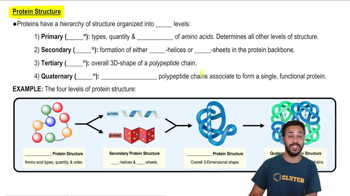
Proteins have four structural levels: primary, secondary, tertiary, and quaternary. The primary structure refers to the linear sequence of amino acids, while secondary structure involves local folding patterns like alpha helices and beta sheets. Tertiary structure is the overall 3D shape formed by interactions among various side chains, and quaternary structure is the assembly of multiple polypeptide chains into a functional protein.
Recommended video:
Guided course
08:02
Protein Structure

Hydrogen Bonding in Proteins

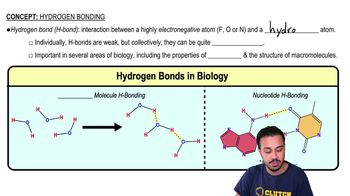
Hydrogen bonds are weak interactions that play a crucial role in stabilizing the secondary and tertiary structures of proteins. They form between polar side chains and contribute to the folding and stability of the protein's 3D shape. Disruption of hydrogen bonds can lead to denaturation, particularly affecting the secondary and tertiary structures, but not the primary structure, which is held together by covalent peptide bonds.
Recommended video:
Guided course
05:03
Hydrogen Bonding

Impact of Disruption on Protein Structure

When considering the impact of disruptions, the primary structure is least affected by hydrogen bonding disruptions because it is determined solely by the sequence of amino acids linked by peptide bonds. In contrast, secondary, tertiary, and quaternary structures rely heavily on hydrogen bonds and other non-covalent interactions for their stability. Therefore, changes in hydrogen bonding primarily influence the higher levels of protein structure.
Recommended video:
Guided course
08:02
Protein Structure