Pearson+ LogoPearson+ Logo
Ch. 3 The Molecules of Cells
Taylor - Campbell Biology: Concepts & Connections 10th Edition
Taylor, Simon, Dickey, Hogan10th EditionCampbell Biology: Concepts & ConnectionsISBN: 9780136538783Not the one you use?Change textbook
Chapter 3, Problem 10

Circle and name the functional groups in this organic molecule. What type of compound is this?
For which class of macromolecules is it a monomer?
Structural formula of an organic molecule with functional groups labeled for biology course.

Verified step by step guidance
1
Step 1: Identify the functional groups in the molecule. Functional groups are specific groups of atoms within molecules that are responsible for the characteristic chemical reactions of those molecules. In this structure, you can see an amino group (-NH₂), a carboxyl group (-COOH), and a hydroxyl group (-OH).
Step 2: Name the functional groups. The amino group (-NH₂) is a basic group, the carboxyl group (-COOH) is an acidic group, and the hydroxyl group (-OH) is a polar group often involved in hydrogen bonding.
Step 3: Determine the type of compound. This molecule is an amino acid because it contains both an amino group and a carboxyl group attached to the same central carbon atom (the alpha carbon).
Step 4: Classify the macromolecule. Amino acids are monomers for proteins, which are one of the four major classes of macromolecules in biology.
Step 5: Summarize the findings. This molecule is an amino acid, specifically serine (based on the hydroxyl group attached to the side chain). It serves as a building block for proteins, which are essential macromolecules in living organisms.

Verified video answer for a similar problem:

This video solution was recommended by our tutors as helpful for the problem above.
Video duration:
1m
Was this helpful?

Key Concepts

Here are the essential concepts you must grasp in order to answer the question correctly.

Functional Groups

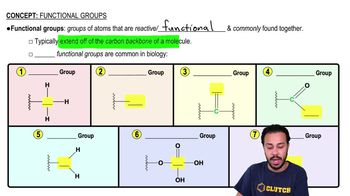
Functional groups are specific groups of atoms within molecules that are responsible for the characteristic chemical reactions of those molecules. In organic chemistry, common functional groups include hydroxyl (-OH), carboxyl (-COOH), amino (-NH2), and others. Identifying these groups helps in understanding the properties and reactivity of the organic molecule.
Recommended video:
Guided course
06:04
Functional Groups

Types of Organic Compounds

Organic compounds are classified based on their structure and functional groups. The molecule in the image contains both amino and hydroxyl groups, indicating it is likely an amino acid. Amino acids are the building blocks of proteins, which are essential macromolecules in biological systems.
Recommended video:
Guided course
06:52
Organization of DNA in the Cell

Macromolecules and Monomers

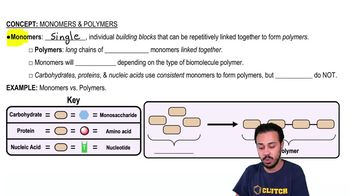
Macromolecules are large, complex molecules essential for life, including proteins, nucleic acids, carbohydrates, and lipids. Monomers are the smaller units that combine to form these macromolecules. In this case, the organic molecule is a monomer for proteins, specifically an amino acid, which links together to form polypeptides and proteins.
Recommended video:
Guided course
03:42
Monomers & Polymers