Pearson+ LogoPearson+ Logo
Ch. 28 Nervous Systems
Taylor - Campbell Biology: Concepts & Connections 10th Edition
Taylor, Simon, Dickey, Hogan10th EditionCampbell Biology: Concepts & ConnectionsISBN: 9780136538783Not the one you use?Change textbook
Chapter 28, Problem 4

What causes a nerve signal to move from one end of a neuron along the length of the neuron to the other end? What is a nerve signal, exactly? Why can't it go backward? How is a nerve signal transmitted from one neuron to the next across a synapse? Write a short paragraph that answers these questions.

Verified step by step guidance
1
Understand that a nerve signal, or action potential, is an electrical impulse that travels along the membrane of a neuron. It is caused by the movement of ions across the neuron's membrane through ion channels.
Learn about the role of the resting membrane potential, which is the difference in electric charge across the membrane in a resting state. This potential is crucial for the initiation and propagation of the action potential.
Recognize that the action potential moves in one direction—from the axon hillock (near the cell body) to the axon terminals—due to the sequential opening and closing of ion channels and the refractory period that prevents immediate reactivation of the channels.
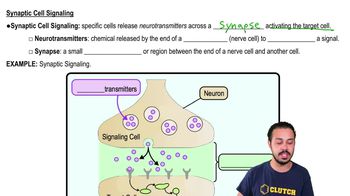
Explore how the nerve signal is transmitted across a synapse, the junction between two neurons. When the action potential reaches the axon terminal, it triggers the release of neurotransmitters into the synaptic cleft. These neurotransmitters bind to receptors on the postsynaptic neuron, initiating a new action potential.
Consider the importance of neurotransmitters and their specific receptors in ensuring the correct transmission of nerve signals across synapses, and how this process ensures that signals are sent to the correct target cells.

Verified video answer for a similar problem:

This video solution was recommended by our tutors as helpful for the problem above.
Video duration:
1m
Was this helpful?

Key Concepts

Here are the essential concepts you must grasp in order to answer the question correctly.

Nerve Signal (Action Potential)

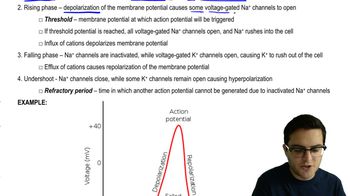
A nerve signal, or action potential, is a rapid change in the electrical charge across a neuron's membrane, triggered by the movement of ions, particularly sodium and potassium. This electrical impulse travels along the axon of the neuron, allowing for communication within the nervous system. The action potential is an all-or-nothing response, meaning it either occurs fully or not at all, depending on whether the threshold is reached.
Recommended video:
Guided course
09:55
Action Potential

Propagation of Nerve Signals

The propagation of nerve signals along a neuron occurs through a process called depolarization and repolarization. When a segment of the axon depolarizes, it causes adjacent segments to also depolarize, creating a wave-like effect. This unidirectional movement is facilitated by the refractory period, during which the neuron cannot fire again immediately, ensuring that signals travel in one direction toward the axon terminals.
Recommended video:
Guided course
06:10
Signal Amplification

Synaptic Transmission

Synaptic transmission is the process by which a nerve signal is transmitted from one neuron to another across a synapse. When the action potential reaches the axon terminal, it triggers the release of neurotransmitters into the synaptic cleft. These chemicals bind to receptors on the postsynaptic neuron, leading to the generation of a new action potential if the signal is strong enough, thus continuing the communication in the nervous system.
Recommended video:
Guided course
02:50
Synaptic Cell Signaling
Related Practice
Textbook Question
Test your understanding of the nervous system by matching the following labels with their corresponding letters: CNS, effector cells, interneuron, motor neuron, PNS, sensory neuron, sensory receptor, spinal cord, synapse.

2067
views
Textbook Question
The inside of the neuron has a lower concentration of positive ions than the outside of the neuron. Is the membrane potential positive or negative?
1424
views
Textbook Question

Fill in the blanks to match some brain structures with their associated functions.

a. If the ___________ is severed, the right and left cerebral hemispheres cannot communicate.

b. The ___________ system helps store emotional memories.

c. Accounting for most of the weight of your brain is the highly folded ___________ ; it is the outer region of the ___________ .

d. The ___________ is responsible for hand-eye coordination.

e. The ___________ contains a cluster of neurons that function as the biological clock.

1954
views
Textbook Question

Joe accidentally touched a hot pan. His arm jerked back, and an instant later, he felt a burning pain. How would you explain the fact that his arm moved before he felt the pain?

a. His limbic system blocked the pain momentarily, but the important pain signals eventually got through.

b. His response was a spinal cord reflex that occurred before the pain signals reached the brain.

c. Motor neurons are myelinated; sensory neurons are not. The signals traveled faster to his muscles.

d. This scenario is not actually possible. The brain must register pain before a person can react.

1025
views
Textbook Question

Which division of the autonomic nervous system would you expect to be activated if a person heard an intruder at the front door?

a. Parasympathetic

b. Sympathetic

c. Enteric

1291
views
Textbook Question

Anesthetics block pain by blocking the transmission of nerve signals. Which of these three chemicals might work as anesthetics? (Choose all that apply and explain your selections.)

a. A chemical that prevents the opening of voltage-gated Na+ channels in membranes

b. A chemical that inhibits the enzymes that degrade neurotransmitters

c. A chemical that blocks neurotransmitter receptors

968
views