Pearson+ LogoPearson+ Logo
Ch. 28 Nervous Systems
Taylor - Campbell Biology: Concepts & Connections 10th Edition
Taylor, Simon, Dickey, Hogan10th EditionCampbell Biology: Concepts & ConnectionsISBN: 9780136538783Not the one you use?Change textbook
Chapter 28, Problem 5

Joe accidentally touched a hot pan. His arm jerked back, and an instant later, he felt a burning pain. How would you explain the fact that his arm moved before he felt the pain?
a. His limbic system blocked the pain momentarily, but the important pain signals eventually got through.
b. His response was a spinal cord reflex that occurred before the pain signals reached the brain.
c. Motor neurons are myelinated; sensory neurons are not. The signals traveled faster to his muscles.
d. This scenario is not actually possible. The brain must register pain before a person can react.

Verified step by step guidance
1
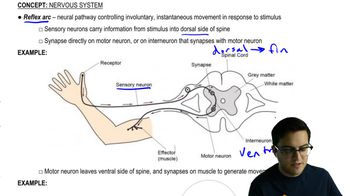
Step 1: Begin by understanding the concept of reflex actions. Reflexes are automatic, involuntary responses to stimuli that occur without conscious thought. They are designed to protect the body from harm and are mediated by the spinal cord rather than the brain.
Step 2: Recognize the role of the spinal cord in reflex actions. When Joe touched the hot pan, sensory neurons in his skin detected the heat and sent signals to the spinal cord. The spinal cord then immediately activated motor neurons to move his arm away from the pan, bypassing the brain for faster response.
Step 3: Consider the delay in pain perception. Pain signals are transmitted by sensory neurons to the brain, where they are processed and interpreted. This process takes slightly longer than the reflex action because it involves higher-level processing in the brain.
Step 4: Evaluate the options provided in the question. Option b correctly describes the mechanism: Joe's response was a spinal cord reflex that occurred before the pain signals reached the brain. The other options either misrepresent the physiological process or are incorrect.
Step 5: Conclude that reflex actions are a critical survival mechanism, allowing the body to respond quickly to harmful stimuli before the brain has fully processed the sensation of pain.

Verified video answer for a similar problem:

This video solution was recommended by our tutors as helpful for the problem above.
Video duration:
2m
Was this helpful?

Key Concepts

Here are the essential concepts you must grasp in order to answer the question correctly.

Reflex Arc

A reflex arc is a neural pathway that controls a reflex action. It typically involves sensory neurons that detect a stimulus, interneurons in the spinal cord, and motor neurons that trigger a response. This process allows for rapid reactions to stimuli, such as pulling away from a hot surface, without the delay of processing the information in the brain.
Recommended video:

Pain Perception

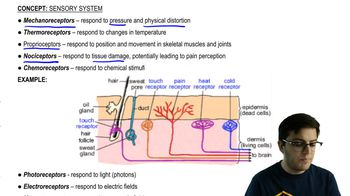
Pain perception is the process by which the brain interprets signals from sensory neurons that indicate damage or potential harm. While pain signals travel to the brain, reflex actions can occur simultaneously through the spinal cord, allowing for immediate responses to harmful stimuli before the sensation of pain is consciously felt.
Recommended video:
Guided course
02:54
Sensory Receptors

Myelination and Signal Transmission

Myelination refers to the presence of a fatty sheath around certain neurons, which increases the speed of electrical signal transmission. Motor neurons are often myelinated, allowing them to transmit signals quickly to muscles, while sensory neurons may not be as heavily myelinated, resulting in slower signal transmission to the brain. This difference can influence the timing of reflex actions versus pain perception.
Recommended video:
Guided course
06:10
Signal Amplification
Related Practice
Textbook Question
The inside of the neuron has a lower concentration of positive ions than the outside of the neuron. Is the membrane potential positive or negative?
1424
views
Textbook Question

Fill in the blanks to match some brain structures with their associated functions.

a. If the ___________ is severed, the right and left cerebral hemispheres cannot communicate.

b. The ___________ system helps store emotional memories.

c. Accounting for most of the weight of your brain is the highly folded ___________ ; it is the outer region of the ___________ .

d. The ___________ is responsible for hand-eye coordination.

e. The ___________ contains a cluster of neurons that function as the biological clock.

1954
views
Textbook Question
What causes a nerve signal to move from one end of a neuron along the length of the neuron to the other end? What is a nerve signal, exactly? Why can't it go backward? How is a nerve signal transmitted from one neuron to the next across a synapse? Write a short paragraph that answers these questions.
1094
views
Textbook Question

Which division of the autonomic nervous system would you expect to be activated if a person heard an intruder at the front door?

a. Parasympathetic

b. Sympathetic

c. Enteric

1291
views
Textbook Question

Anesthetics block pain by blocking the transmission of nerve signals. Which of these three chemicals might work as anesthetics? (Choose all that apply and explain your selections.)

a. A chemical that prevents the opening of voltage-gated Na+ channels in membranes

b. A chemical that inhibits the enzymes that degrade neurotransmitters

c. A chemical that blocks neurotransmitter receptors

968
views
Textbook Question

A proposal to test an SSRI in a large number of individuals with depression was submitted to the FDA. Through random assignments, half of the patients would be controls, receiving nothing at all, and half the patients would receive the drug in pill form. Patients in both groups would note changes in their own mood in a daily journal. What flaw(s) do you note in this experimental design?

811
views