

Pearson+ LogoPearson+ Logo
Ch. 14 The Origin of Species
Taylor - Campbell Biology: Concepts & Connections 10th Edition
Taylor, Simon, Dickey, Hogan10th EditionCampbell Biology: Concepts & ConnectionsISBN: 9780136538783Not the one you use?Change textbook
Chapter 14, Problem 7

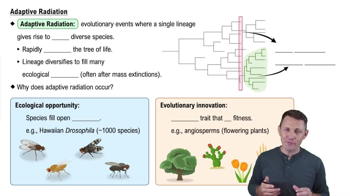
Biologists have found more than 500 species of fruit flies on the various Hawaiian Islands, all apparently descended from a single ancestor species. This example illustrates
a. Polyploidy.
b. Temporal isolation.
c. Adaptive radiation.
d. Sympatric speciation.

Verified step by step guidance
1
Understand the concept of adaptive radiation: Adaptive radiation occurs when a single ancestral species rapidly diversifies into many new species, each adapted to a specific ecological niche. This often happens in isolated environments, such as islands, where there are many unoccupied niches.
Analyze the scenario: The problem states that more than 500 species of fruit flies have been found on the Hawaiian Islands, all descended from a single ancestor species. This suggests a process where one species diversified into many species to exploit different ecological opportunities.
Eliminate unrelated options: a) Polyploidy refers to the duplication of chromosomes, which is common in plants but not relevant here. b) Temporal isolation refers to species being reproductively isolated due to differences in mating times, which is not mentioned in the problem. d) Sympatric speciation occurs without geographic isolation, but the Hawaiian Islands provide geographic isolation, making this less likely.
Focus on the correct option: c) Adaptive radiation is the most fitting explanation, as it describes the diversification of a single species into multiple species in a geographically isolated environment like the Hawaiian Islands.
Conclude: The example of fruit flies on the Hawaiian Islands illustrates adaptive radiation, as it involves the diversification of a single ancestor species into many species adapted to different ecological niches.

Verified video answer for a similar problem:

This video solution was recommended by our tutors as helpful for the problem above.
Video duration:
1m
Was this helpful?

Key Concepts

Here are the essential concepts you must grasp in order to answer the question correctly.

Adaptive Radiation

Adaptive radiation is an evolutionary process in which organisms diversify rapidly into a wide variety of forms to adapt to different environments. This often occurs when a species colonizes a new habitat with diverse ecological niches, leading to the emergence of new species from a common ancestor, as seen with the fruit flies in Hawaii.
Recommended video:
05:24
Adaptive Radiation

Speciation

Speciation is the evolutionary process by which populations evolve to become distinct species. It can occur through various mechanisms, including geographic isolation, reproductive isolation, and adaptive radiation, where a single ancestral species gives rise to multiple new species adapted to different environments.
Recommended video:
Guided course
02:53
Allopatric Speciation

Common Ancestry

Common ancestry refers to the concept that different species share a common ancestor from which they have diverged over time. This principle is fundamental to evolutionary biology, illustrating how diverse species, like the Hawaiian fruit flies, can evolve from a single ancestral species through processes such as adaptive radiation.
Recommended video:
06:39
Common Misconceptions
Related Practice
Textbook Question

According to the biological species concept, species are defined by their

a. Particular roles in a biological community.

b. Ability to interbreed and produce viable, fertile offspring.

c. Reproductive isolation from nearby populations.

d. Common ancestry.

2181
views
Textbook Question

Bird guides once listed the myrtle warbler and Audubon's warbler as distinct species that lived side by side in parts of their ranges. However, recent books show them as eastern and western forms of a single species, the yellow-rumped warbler. Most likely, it has been found that these two kinds of warblers

a. Live in similar habitats and eat similar foods.

b. Interbreed often in nature, and the offspring are viable and fertile.

c. Are almost identical in appearance.

d. Have many genes in common.

869
views
Textbook Question

Which of the following is an example of a postzygotic reproductive barrier?

a. One Ceanothus shrub lives on acid soil, another on alkaline soil.

b. Mallard and pintail ducks mate at different times of year.

c. Two species of leopard frogs have different mating calls.

d. Hybrid offspring of two species of jimsonweeds always die before reproducing.

1545
views
Textbook Question

A new plant species C, which formed from hybridization of species A(2n = 16) with species B(2n = 12), would probably produce gametes with a chromosome number of

a. 12.

b. 14.

c. 16.

d. 28.

1044
views
Textbook Question

A horse (2n = 64) and a donkey (2n = 62) can mate and produce a mule. How many chromosomes would there be in a mule's body cells?

a. 31

b. 62

c. 63

d. 126

1656
views
Textbook Question

What prevents horses and donkeys from hybridizing to form a new species?

a. Limited hybrid fertility

b. Limited hybrid viability

c. Hybrid breakdown

d. Gametic isolation

1037
views