
Pearson+ LogoPearson+ Logo
Ch. 14 The Origin of Species
Taylor - Campbell Biology: Concepts & Connections 10th Edition
Taylor, Simon, Dickey, Hogan10th EditionCampbell Biology: Concepts & ConnectionsISBN: 9780136538783Not the one you use?Change textbook
Chapter 14, Problem 9

A horse (2n = 64) and a donkey (2n = 62) can mate and produce a mule. How many chromosomes would there be in a mule's body cells?
a. 31
b. 62
c. 63
d. 126

Verified step by step guidance
1
Step 1: Understand the chromosome numbers of the parents. The horse has a diploid chromosome number of 64 (2n = 64), and the donkey has a diploid chromosome number of 62 (2n = 62).
Step 2: Recall that during sexual reproduction, each parent contributes half of their chromosomes to the offspring. This means the horse will contribute 32 chromosomes (n = 64 / 2), and the donkey will contribute 31 chromosomes (n = 62 / 2).
Step 3: Add the haploid contributions from both parents to determine the total number of chromosomes in the mule. Use the formula: \( \text{Total chromosomes} = \text{Horse contribution} + \text{Donkey contribution} \).
Step 4: Recognize that the mule inherits one set of chromosomes from each parent, resulting in a hybrid chromosome count. This hybrid count is the sum of the haploid contributions from the horse and donkey.
Step 5: Verify that the mule's chromosome count represents the total number of chromosomes in its body cells, which are diploid (2n). This is because body cells contain the full set of chromosomes inherited from both parents.

Verified video answer for a similar problem:

This video solution was recommended by our tutors as helpful for the problem above.
Video duration:
36s
Was this helpful?

Key Concepts

Here are the essential concepts you must grasp in order to answer the question correctly.

Chromosome Number

Chromosome number refers to the total count of chromosomes in a cell. In diploid organisms, this number is represented as 2n, where n is the number of pairs of chromosomes. For horses, the diploid number is 64 (2n = 64), and for donkeys, it is 62 (2n = 62). Understanding the chromosome number is essential for determining the genetic makeup of hybrid offspring.
Recommended video:
Guided course
08:09
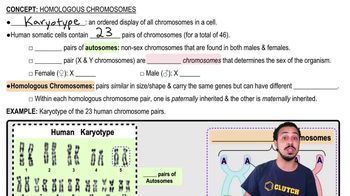
Homologous Chromosomes

Hybrid Offspring

Hybrid offspring are the result of mating between two different species or breeds, leading to a combination of genetic material from both parents. In this case, a mule is a hybrid resulting from the mating of a horse and a donkey. Hybrids often have an intermediate number of chromosomes, which can affect their fertility and other biological traits.
Recommended video:
04:38
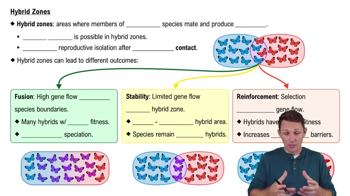
Hybrid Zones

Chromosome Inheritance in Hybrids

In hybrids like mules, the chromosome count is typically the average of the two parent species, but it may not be a whole number. Mules inherit 32 chromosomes from the horse and 31 from the donkey, resulting in a total of 63 chromosomes (2n = 63). This unique chromosome number is significant as it often leads to sterility in hybrids due to mismatched chromosome pairing during meiosis.
Recommended video:
04:38
Hybrid Zones
Related Practice
Textbook Question

Which of the following is an example of a postzygotic reproductive barrier?

a. One Ceanothus shrub lives on acid soil, another on alkaline soil.

b. Mallard and pintail ducks mate at different times of year.

c. Two species of leopard frogs have different mating calls.

d. Hybrid offspring of two species of jimsonweeds always die before reproducing.

1545
views
Textbook Question

Biologists have found more than 500 species of fruit flies on the various Hawaiian Islands, all apparently descended from a single ancestor species. This example illustrates

a. Polyploidy.

b. Temporal isolation.

c. Adaptive radiation.

d. Sympatric speciation.

1138
views
Textbook Question

A new plant species C, which formed from hybridization of species A(2n = 16) with species B(2n = 12), would probably produce gametes with a chromosome number of

a. 12.

b. 14.

c. 16.

d. 28.

1044
views
Textbook Question

What prevents horses and donkeys from hybridizing to form a new species?

a. Limited hybrid fertility

b. Limited hybrid viability

c. Hybrid breakdown

d. Gametic isolation

1037
views
Textbook Question

When hybrids produced in a hybrid zone can breed with each other and with both parent species, and they survive and reproduce as well as members of the parent species, one would predict that

a. The hybrid zone would be stable.

b. Sympatric speciation would occur.

c. Reinforcement of reproductive barriers would keep the parent species separate.

d. Reproductive barriers would lessen and the two parent species would fuse.

1670
views
Textbook Question

Which of the following factors would not contribute to allopatric speciation?

a. A population becomes geographically isolated from the parent population.

b. The separated population is small, and genetic drift occurs.

c. The isolated population is exposed to different selection pressures than the parent population.

d. Gene flow between the two populations continues to occur.

1437
views