
Textbook Question
Which concept of species would be most useful to a field biologist identifying new plant species in a tropical forest?
a. Biological
b. Ecological
c. Morphological
d. Phylogenetic
1499
views


 Verified step by step guidance
 03:28
03:28 03:28
03:28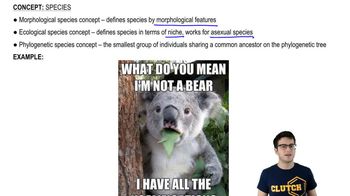 02:53
02:53Which concept of species would be most useful to a field biologist identifying new plant species in a tropical forest?
a. Biological
b. Ecological
c. Morphological
d. Phylogenetic
According to the biological species concept, species are defined by their
a. Particular roles in a biological community.
b. Ability to interbreed and produce viable, fertile offspring.
c. Reproductive isolation from nearby populations.
d. Common ancestry.
Bird guides once listed the myrtle warbler and Audubon's warbler as distinct species that lived side by side in parts of their ranges. However, recent books show them as eastern and western forms of a single species, the yellow-rumped warbler. Most likely, it has been found that these two kinds of warblers
a. Live in similar habitats and eat similar foods.
b. Interbreed often in nature, and the offspring are viable and fertile.
c. Are almost identical in appearance.
d. Have many genes in common.
Biologists have found more than 500 species of fruit flies on the various Hawaiian Islands, all apparently descended from a single ancestor species. This example illustrates
a. Polyploidy.
b. Temporal isolation.
c. Adaptive radiation.
d. Sympatric speciation.
A new plant species C, which formed from hybridization of species A(2n = 16) with species B(2n = 12), would probably produce gametes with a chromosome number of
a. 12.
b. 14.
c. 16.
d. 28.
A horse (2n = 64) and a donkey (2n = 62) can mate and produce a mule. How many chromosomes would there be in a mule's body cells?
a. 31
b. 62
c. 63
d. 126