Pearson+ LogoPearson+ Logo
Ch. 14 The Origin of Species
Taylor - Campbell Biology: Concepts & Connections 10th Edition
Taylor, Simon, Dickey, Hogan10th EditionCampbell Biology: Concepts & ConnectionsISBN: 9780136538783Not the one you use?Change textbook
Chapter 14, Problem 16

Can factors that cause sympatric speciation also cause allopatric speciation? Explain.

Verified step by step guidance
1
Understand the definitions: Sympatric speciation occurs when new species evolve from a single ancestral species while inhabiting the same geographic region. Allopatric speciation, on the other hand, occurs when biological populations of the same species become isolated from each other to an extent that prevents or interferes with genetic interchange.
Identify common factors: Both sympatric and allopatric speciation can be influenced by similar evolutionary processes such as natural selection, genetic drift, and mutation. These factors can lead to reproductive isolation, which is crucial for speciation.
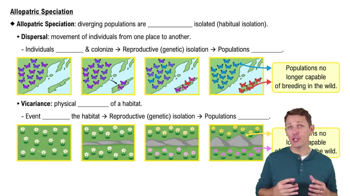
Consider the role of geographic isolation: In allopatric speciation, geographic isolation is a key factor, which is not a requirement in sympatric speciation. However, other mechanisms like ecological niches or sexual selection can play similar roles in both speciation types, leading to reproductive isolation within the same area or in physically separated populations.
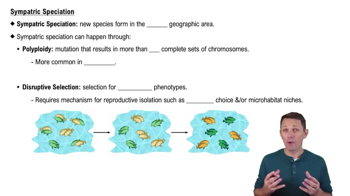
Analyze the impact of genetic factors: Genetic mutations and chromosomal changes can lead to reproductive barriers in both sympatric and allopatric speciation. For instance, polyploidy (having more than two sets of chromosomes) can cause instant reproductive isolation sympatrically and could also contribute to divergence in allopatric populations.
Evaluate the role of environmental factors: Changes in the environment, such as shifts in climate or habitat, can influence both sympatric and allopatric speciation by altering the selective pressures on populations, regardless of whether they are geographically separated or not.

Verified video answer for a similar problem:

This video solution was recommended by our tutors as helpful for the problem above.
Video duration:
2m
Was this helpful?

Key Concepts

Here are the essential concepts you must grasp in order to answer the question correctly.

Sympatric Speciation

Sympatric speciation occurs when new species arise from a single ancestral species while inhabiting the same geographic region. This process often involves reproductive isolation mechanisms, such as behavioral changes, polyploidy in plants, or habitat differentiation, which prevent interbreeding despite the proximity of populations.
Recommended video:
03:57
Sympatric Speciation

Allopatric Speciation

Allopatric speciation is the process by which new species form when populations are geographically isolated from one another. This separation can occur due to physical barriers like mountains or rivers, leading to genetic divergence over time as the isolated populations adapt to their unique environments.
Recommended video:
03:53
Allopatric Speciation

Speciation Mechanisms

Speciation mechanisms are the biological processes that lead to the formation of new species. These mechanisms can be categorized into prezygotic barriers, which prevent mating or fertilization, and postzygotic barriers, which occur after fertilization and affect the viability or fertility of the offspring. Understanding these mechanisms is crucial for analyzing how different factors can influence both sympatric and allopatric speciation.
Recommended video:
Guided course
02:53
Allopatric Speciation
Related Practice
Textbook Question
Explain how each of the following makes it difficult to clearly define a species: variation within a species, geographically isolated populations, asexual species, fossil organisms.
1268
views
Textbook Question
Explain why allopatric speciation would be less likely on an island close to a mainland than on a more isolated island.
1333
views
Textbook Question
What does the term punctuated equilibria describe?
952
views
Textbook Question
Cultivated American cotton plants have a total of 52 chromosomes (2n = 52). In each cell, there are 13 pairs of large chromosomes and 13 pairs of smaller chromosomes. Old World cotton plants have 26 chromosomes (2n = 26), all large. Wild American cotton plants have 26 chromosomes, all small. Propose a testable hypothesis to explain how cultivated American cotton probably originated.
1290
views
Textbook Question

Explain how the murky waters of Lake Victoria may be contributing to the decline in cichlid species. How might these polluted waters affect the formation of new species?

888
views
Textbook Question
The red wolf, Canis rufus, which was once widespread in the southeastern and south central United States, was declared extinct in the wild by 1980. Saved by a captive breeding program, the red wolf has been reintroduced in areas of eastern North Carolina. The current wild population is estimated to be about 100 individuals. It is presently being threatened with extinction due to hybridization with coyotes, Canis latrans, which have become more numerous in the area. Red wolves and coyotes differ in terms of morphology, DNA, and behavior, although these differences may disappear if interbreeding continues. Although the red wolf has been designated as an endangered species under the Endangered Species Act, some people think that its endangered status should be withdrawn and resources should not be spent to protect what is not a 'pure' species. Do you agree? Why or why not?
1204
views