Pearson+ LogoPearson+ Logo
Ch. 14 The Origin of Species
Taylor - Campbell Biology: Concepts & Connections 10th Edition
Taylor, Simon, Dickey, Hogan10th EditionCampbell Biology: Concepts & ConnectionsISBN: 9780136538783Not the one you use?Change textbook
Chapter 14, Problem 17

Cultivated American cotton plants have a total of 52 chromosomes (2n = 52). In each cell, there are 13 pairs of large chromosomes and 13 pairs of smaller chromosomes. Old World cotton plants have 26 chromosomes (2n = 26), all large. Wild American cotton plants have 26 chromosomes, all small. Propose a testable hypothesis to explain how cultivated American cotton probably originated.

Verified step by step guidance
1
Identify the chromosome counts and types in each variety of cotton: Cultivated American cotton has 52 chromosomes (26 large and 26 small), Old World cotton has 26 large chromosomes, and Wild American cotton has 26 small chromosomes.
Consider the concept of hybridization, where two different species interbreed to produce a hybrid that combines traits from both parent species.
Formulate a hypothesis that cultivated American cotton (2n = 52) may have originated from a hybridization event between Old World cotton (2n = 26, all large chromosomes) and Wild American cotton (2n = 26, all small chromosomes).
Propose that the hybridization led to a doubling of the chromosome number (allopolyploidy), resulting in a stable new species with 52 chromosomes, inheriting 13 large chromosome pairs from Old World cotton and 13 small chromosome pairs from Wild American cotton.
Suggest experiments to test this hypothesis, such as genetic analysis to compare DNA sequences among the three cotton types or breeding experiments to attempt to recreate the hybridization event.

Verified video answer for a similar problem:

This video solution was recommended by our tutors as helpful for the problem above.
Video duration:
1m
Was this helpful?

Key Concepts

Here are the essential concepts you must grasp in order to answer the question correctly.

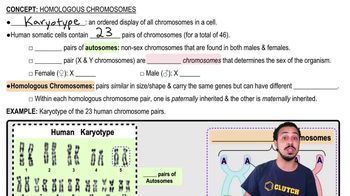
Chromosome Number and Structure

Chromosomes are structures within cells that contain DNA and genetic information. The notation '2n' indicates the diploid number of chromosomes, meaning there are two sets, one from each parent. In the case of cultivated American cotton, the total of 52 chromosomes suggests a complex evolutionary history involving hybridization and polyploidy, where multiple sets of chromosomes are present.
Recommended video:
Guided course
08:09
Homologous Chromosomes

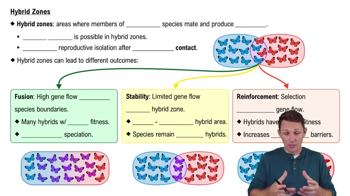
Hybridization

Hybridization is the process where two different species or varieties interbreed to produce offspring with mixed genetic traits. In the context of cotton, cultivated American cotton likely originated from the hybridization of Old World cotton and wild American cotton, leading to a new variety with distinct characteristics, such as increased chromosome number and size variation.
Recommended video:
04:38
Hybrid Zones

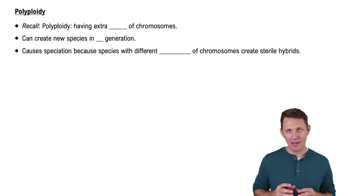
Polyploidy

Polyploidy refers to the condition of having more than two complete sets of chromosomes. This phenomenon is common in plants and can result from hybridization events. The cultivated American cotton's 52 chromosomes suggest that it may have undergone polyploidy, possibly through the fusion of gametes from different cotton species, contributing to its genetic diversity and adaptability.
Recommended video:
05:53
Polyploidy