Pearson+ LogoPearson+ Logo
Ch. 14 The Origin of Species
Taylor - Campbell Biology: Concepts & Connections 10th Edition
Taylor, Simon, Dickey, Hogan10th EditionCampbell Biology: Concepts & ConnectionsISBN: 9780136538783Not the one you use?Change textbook
Chapter 14, Problem 2

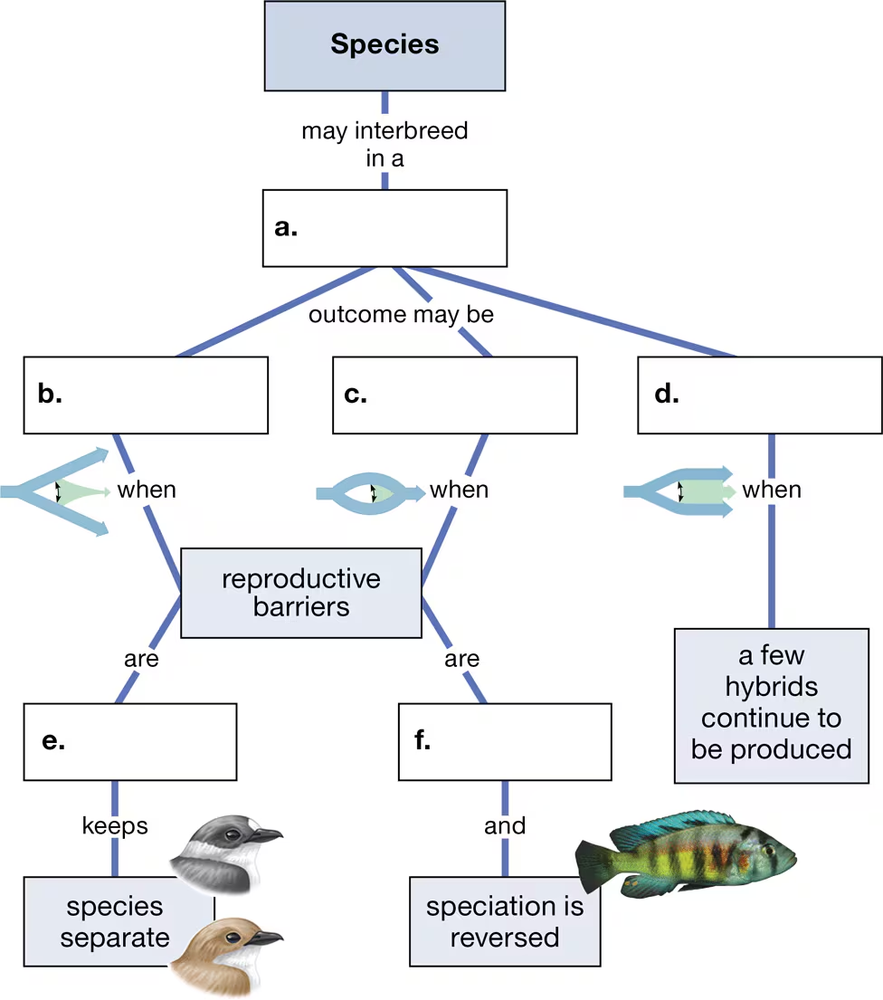
Fill in the blanks in the following concept map.
Concept map illustrating species interbreeding outcomes and reproductive barriers, featuring birds and fish images.

Verified step by step guidance
1
Step 1: Identify the main topic or concept that the concept map is centered around. This will serve as the starting point for filling in the blanks.
Step 2: Analyze the relationships between the main topic and the subtopics or branches. Look for clues in the structure of the concept map to determine how the blanks might connect to the main idea.
Step 3: Use your knowledge of biology to match the blanks with appropriate terms or concepts. For example, if the concept map is about cellular respiration, the blanks might include terms like 'glycolysis,' 'Krebs cycle,' or 'electron transport chain.'
Step 4: Verify that the terms you have chosen logically fit into the concept map and accurately represent the relationships between the main topic and subtopics.
Step 5: Double-check your answers to ensure that all blanks are filled with relevant and accurate biological terms or concepts, and that the overall map makes sense.

Verified video answer for a similar problem:

This video solution was recommended by our tutors as helpful for the problem above.
Video duration:
2m
Was this helpful?

Key Concepts

Here are the essential concepts you must grasp in order to answer the question correctly.

Concept Maps

Concept maps are visual representations of relationships between concepts. They typically consist of nodes (representing concepts) connected by lines that indicate the relationships between them. This tool helps in organizing and structuring knowledge, making it easier to understand complex topics by illustrating how different ideas are interconnected.
Recommended video:
03:24
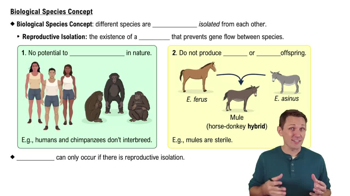
Biological Species Concept

Biological Hierarchy

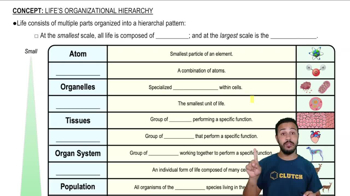
The biological hierarchy is a way of organizing living organisms into levels of complexity, ranging from atoms and molecules to cells, tissues, organs, organisms, populations, communities, ecosystems, and the biosphere. Understanding this hierarchy is crucial for grasping how biological systems function and how different levels interact with one another.
Recommended video:
Guided course
09:50
Life's Organizational Hierarchy

Key Biological Processes

Key biological processes include essential functions such as cellular respiration, photosynthesis, and reproduction. These processes are fundamental to life, as they govern how organisms obtain energy, grow, and reproduce. Familiarity with these processes is vital for filling in concept maps related to biological systems and understanding the flow of energy and matter in ecosystems.
Recommended video:
Guided course
06:04
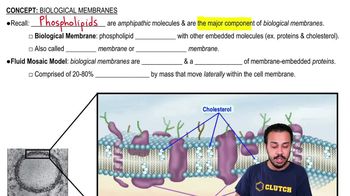
Biological Membranes