Pearson+ LogoPearson+ Logo
Ch. 14 The Origin of Species
Taylor - Campbell Biology: Concepts & Connections 10th Edition
Taylor, Simon, Dickey, Hogan10th EditionCampbell Biology: Concepts & ConnectionsISBN: 9780136538783Not the one you use?Change textbook
Chapter 14, Problem 1

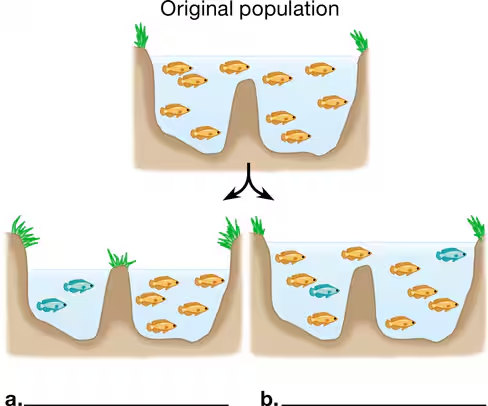
Name the two types of speciation represented by this diagram. For each type, describe how reproductive barriers may develop between the new species.
Diagram illustrating speciation with two populations of crabs separated by a barrier, showing potential reproductive barriers.

Verified step by step guidance
1
Identify the two types of speciation: Speciation is generally categorized into two main types based on the geographic context—Allopatric speciation and Sympatric speciation. These terms describe how populations become reproductively isolated.
Explain Allopatric Speciation: In allopatric speciation, a population is divided by a physical geographic barrier (e.g., mountains, rivers, or distance). Over time, genetic divergence occurs due to factors like natural selection, genetic drift, and mutation. Reproductive barriers develop as a result of these genetic changes, preventing interbreeding even if the populations come back into contact.
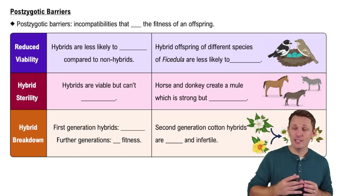
Describe Reproductive Barriers in Allopatric Speciation: These barriers can be prezygotic (e.g., differences in mating behaviors, timing, or habitat preferences) or postzygotic (e.g., hybrid offspring being inviable or sterile). These mechanisms ensure that the two populations remain distinct species.
Explain Sympatric Speciation: In sympatric speciation, populations diverge into new species while living in the same geographic area. This can occur due to factors like polyploidy (common in plants), sexual selection, or ecological niche differentiation.
Describe Reproductive Barriers in Sympatric Speciation: Reproductive isolation in sympatric speciation often arises from behavioral changes (e.g., mate preferences), ecological specialization (e.g., using different resources), or chromosomal changes (e.g., polyploidy). These barriers prevent gene flow between the diverging populations, leading to the formation of new species.

Verified video answer for a similar problem:

This video solution was recommended by our tutors as helpful for the problem above.
Video duration:
38s
Was this helpful?

Key Concepts

Here are the essential concepts you must grasp in order to answer the question correctly.

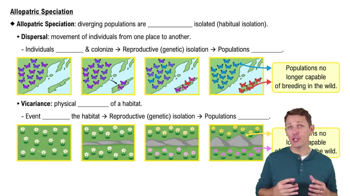
Allopatric Speciation

Allopatric speciation occurs when a population is geographically separated, leading to the development of reproductive barriers. This separation can be caused by physical barriers like mountains or rivers, which prevent individuals from mating. Over time, genetic divergence occurs due to natural selection, mutation, and genetic drift, resulting in two distinct species that can no longer interbreed.
Recommended video:
03:53
Allopatric Speciation

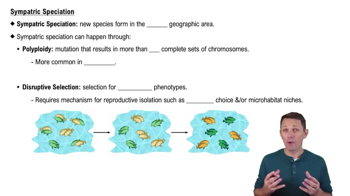
Sympatric Speciation

Sympatric speciation happens when new species arise from a single population without geographical separation. This can occur through mechanisms such as polyploidy in plants, where an increase in chromosome number creates reproductive barriers. Behavioral changes, habitat differentiation, or temporal isolation can also lead to reproductive barriers, allowing species to coexist in the same environment while diverging genetically.
Recommended video:
03:57
Sympatric Speciation

Reproductive Barriers

Reproductive barriers are mechanisms that prevent species from interbreeding, thus maintaining species integrity. These barriers can be prezygotic, such as temporal isolation (different mating seasons) or behavioral isolation (different mating rituals), or postzygotic, such as hybrid inviability (offspring do not survive) or hybrid sterility (offspring are sterile). Understanding these barriers is crucial for explaining how speciation occurs and how biodiversity is maintained.
Recommended video:
03:28
Postzygotic Barriers