Pearson+ LogoPearson+ Logo
Ch. 14 The Origin of Species
Taylor - Campbell Biology: Concepts & Connections 10th Edition
Taylor, Simon, Dickey, Hogan10th EditionCampbell Biology: Concepts & ConnectionsISBN: 9780136538783Not the one you use?Change textbook
Chapter 14, Problem 3

Which concept of species would be most useful to a field biologist identifying new plant species in a tropical forest?
a. Biological
b. Ecological
c. Morphological
d. Phylogenetic

Verified step by step guidance
1
Understand the context of the problem: A field biologist is identifying new plant species in a tropical forest. This means the biologist is likely relying on observable traits and practical methods in the field rather than laboratory-based genetic or reproductive studies.
Review the definitions of the species concepts: The biological species concept defines species based on reproductive isolation, the ecological species concept focuses on ecological niches, the morphological species concept relies on physical traits, and the phylogenetic species concept uses evolutionary relationships.
Consider the practicality of each concept: In a tropical forest, where resources may be limited and immediate observations are crucial, the morphological species concept is often the most useful because it allows identification based on visible traits such as leaf shape, flower structure, or other physical characteristics.
Evaluate why other concepts may be less practical: The biological species concept requires knowledge of reproductive compatibility, which is difficult to assess in the field. The ecological species concept requires detailed knowledge of the organism's role in the ecosystem, which may not be immediately apparent. The phylogenetic species concept requires genetic analysis, which is not feasible in a field setting.
Conclude that the morphological species concept is likely the most useful for a field biologist identifying new plant species in a tropical forest, as it is based on observable traits that can be assessed directly in the field.

Verified video answer for a similar problem:

This video solution was recommended by our tutors as helpful for the problem above.
Video duration:
53s
Was this helpful?

Key Concepts

Here are the essential concepts you must grasp in order to answer the question correctly.

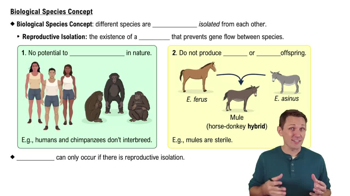
Biological Species Concept

The Biological Species Concept defines a species as a group of organisms that can interbreed and produce fertile offspring. This concept emphasizes reproductive isolation, meaning that members of different species do not typically mate or produce viable offspring. For a field biologist, understanding this concept is crucial when identifying new plant species, as it helps determine whether a new specimen can reproduce with known species.
Recommended video:
03:24
Biological Species Concept

Morphological Species Concept

The Morphological Species Concept classifies species based on observable physical characteristics, such as shape, size, and structure. This approach is particularly useful in field biology, where visual identification is often necessary, especially in diverse ecosystems like tropical forests. By comparing morphological traits, biologists can distinguish between species that may not be easily identifiable through genetic or reproductive methods.
Recommended video:
03:24
Biological Species Concept

Phylogenetic Species Concept

The Phylogenetic Species Concept defines a species as the smallest group of individuals that share a common ancestor, represented by a unique branch on a phylogenetic tree. This concept incorporates evolutionary relationships and genetic data, making it valuable for identifying species based on their evolutionary history. For a field biologist, this approach can provide insights into the diversity and evolutionary significance of newly discovered plant species.
Recommended video:
03:24
Biological Species Concept