Back
Back
Problem 1
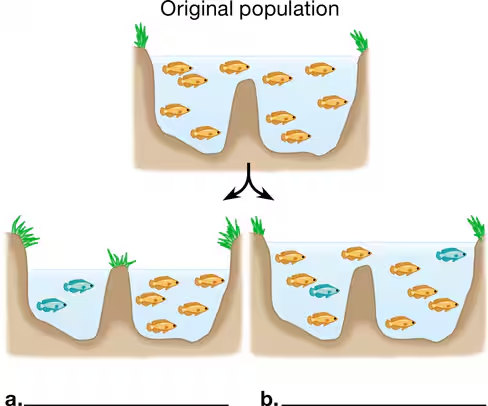
Name the two types of speciation represented by this diagram. For each type, describe how reproductive barriers may develop between the new species.
Problem 2
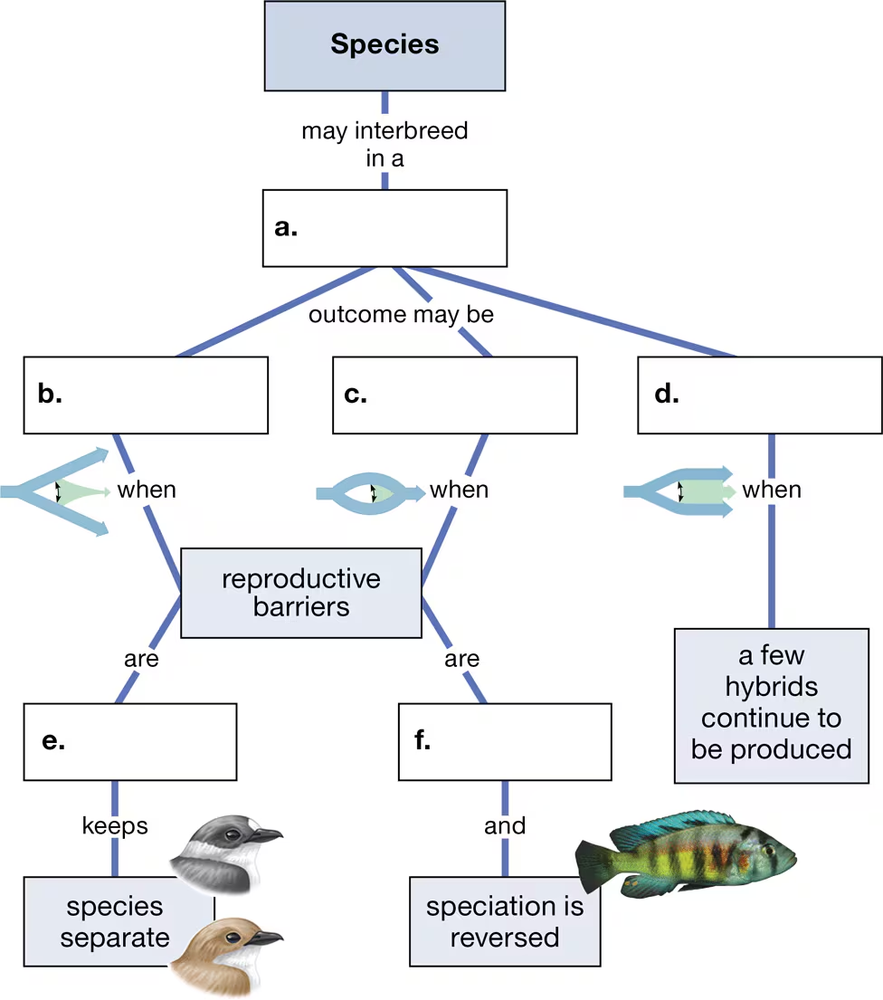
Fill in the blanks in the following concept map.
Problem 3
Which concept of species would be most useful to a field biologist identifying new plant species in a tropical forest?
a. Biological
b. Ecological
c. Morphological
d. Phylogenetic
Problem 4
According to the biological species concept, species are defined by their
a. Particular roles in a biological community.
b. Ability to interbreed and produce viable, fertile offspring.
c. Reproductive isolation from nearby populations.
d. Common ancestry.
Problem 5
Bird guides once listed the myrtle warbler and Audubon's warbler as distinct species that lived side by side in parts of their ranges. However, recent books show them as eastern and western forms of a single species, the yellow-rumped warbler. Most likely, it has been found that these two kinds of warblers
a. Live in similar habitats and eat similar foods.
b. Interbreed often in nature, and the offspring are viable and fertile.
c. Are almost identical in appearance.
d. Have many genes in common.
Problem 6
Which of the following is an example of a postzygotic reproductive barrier?
a. One Ceanothus shrub lives on acid soil, another on alkaline soil.
b. Mallard and pintail ducks mate at different times of year.
c. Two species of leopard frogs have different mating calls.
d. Hybrid offspring of two species of jimsonweeds always die before reproducing.
Problem 7
Biologists have found more than 500 species of fruit flies on the various Hawaiian Islands, all apparently descended from a single ancestor species. This example illustrates
a. Polyploidy.
b. Temporal isolation.
c. Adaptive radiation.
d. Sympatric speciation.
Problem 8
A new plant species C, which formed from hybridization of species A(2n = 16) with species B(2n = 12), would probably produce gametes with a chromosome number of
a. 12.
b. 14.
c. 16.
d. 28.
Problem 9
A horse (2n = 64) and a donkey (2n = 62) can mate and produce a mule. How many chromosomes would there be in a mule's body cells?
a. 31
b. 62
c. 63
d. 126
Problem 10
What prevents horses and donkeys from hybridizing to form a new species?
a. Limited hybrid fertility
b. Limited hybrid viability
c. Hybrid breakdown
d. Gametic isolation
Problem 11
When hybrids produced in a hybrid zone can breed with each other and with both parent species, and they survive and reproduce as well as members of the parent species, one would predict that
a. The hybrid zone would be stable.
b. Sympatric speciation would occur.
c. Reinforcement of reproductive barriers would keep the parent species separate.
d. Reproductive barriers would lessen and the two parent species would fuse.
Problem 12
Which of the following factors would not contribute to allopatric speciation?
a. A population becomes geographically isolated from the parent population.
b. The separated population is small, and genetic drift occurs.
c. The isolated population is exposed to different selection pressures than the parent population.
d. Gene flow between the two populations continues to occur.
- Explain how each of the following makes it difficult to clearly define a species: variation within a species, geographically isolated populations, asexual species, fossil organisms.
Problem 13
- Explain why allopatric speciation would be less likely on an island close to a mainland than on a more isolated island.
Problem 14
- What does the term punctuated equilibria describe?
Problem 15
- Can factors that cause sympatric speciation also cause allopatric speciation? Explain.
Problem 16
- Cultivated American cotton plants have a total of 52 chromosomes (2n = 52). In each cell, there are 13 pairs of large chromosomes and 13 pairs of smaller chromosomes. Old World cotton plants have 26 chromosomes (2n = 26), all large. Wild American cotton plants have 26 chromosomes, all small. Propose a testable hypothesis to explain how cultivated American cotton probably originated.
Problem 17
Problem 18
Explain how the murky waters of Lake Victoria may be contributing to the decline in cichlid species. How might these polluted waters affect the formation of new species?
- The red wolf, Canis rufus, which was once widespread in the southeastern and south central United States, was declared extinct in the wild by 1980. Saved by a captive breeding program, the red wolf has been reintroduced in areas of eastern North Carolina. The current wild population is estimated to be about 100 individuals. It is presently being threatened with extinction due to hybridization with coyotes, Canis latrans, which have become more numerous in the area. Red wolves and coyotes differ in terms of morphology, DNA, and behavior, although these differences may disappear if interbreeding continues. Although the red wolf has been designated as an endangered species under the Endangered Species Act, some people think that its endangered status should be withdrawn and resources should not be spent to protect what is not a 'pure' species. Do you agree? Why or why not?
Problem 19