Pearson+ LogoPearson+ Logo
Ch. 9 Patterns of Inheritance
Taylor - Campbell Biology: Concepts & Connections 10th Edition
Taylor, Simon, Dickey, Hogan10th EditionCampbell Biology: Concepts & ConnectionsISBN: 9780136538783Not the one you use?Change textbook
Chapter 9, Problem 9

A fruit fly with a gray body and red eyes (genotype BbPp) is mated with a fly having a black body and purple eyes (genotype bbpp).
What ratio of offspring would you expect if the body-color and eye-color genes are on different chromosomes (unlinked)?
When this mating is actually carried out, most of the offspring look like the parents, but 3% have a gray body and purple eyes, and 3% have a black body and red eyes.
Are these genes linked or unlinked?
What is the recombination frequency?

Verified step by step guidance
1
Step 1: Begin by analyzing the genotypes of the parent fruit flies. The first parent has the genotype BbPp, which means it is heterozygous for both body color (B = gray, b = black) and eye color (P = red, p = purple). The second parent has the genotype bbpp, which is homozygous recessive for both traits.
Step 2: Since the problem states that the body-color and eye-color genes are on different chromosomes (unlinked), use a Punnett square to determine the expected offspring ratios. For unlinked genes, the alleles segregate independently during gamete formation. Calculate the possible gametes for each parent: BbPp produces BP, Bp, bP, and bp, while bbpp produces only bp.
Step 3: Combine the gametes from both parents in a Punnett square to determine the genotypes and phenotypes of the offspring. The expected phenotypic ratio for unlinked genes is 1:1:1:1, corresponding to gray body/red eyes, gray body/purple eyes, black body/red eyes, and black body/purple eyes.
Step 4: Examine the actual offspring data provided in the problem. Most offspring resemble the parents, but 3% have gray body/purple eyes and 3% have black body/red eyes. This deviation from the expected 1:1:1:1 ratio suggests that the genes may be linked, meaning they are located close together on the same chromosome and do not assort independently.
Step 5: Calculate the recombination frequency to determine the degree of linkage. Recombination frequency is calculated as the percentage of recombinant offspring (those with new combinations of traits, such as gray body/purple eyes and black body/red eyes) out of the total offspring. Use the formula: \( \text{Recombination Frequency} = \frac{\text{Number of Recombinant Offspring}}{\text{Total Number of Offspring}} \times 100 \). Substitute the given values to find the recombination frequency.

Verified video answer for a similar problem:

This video solution was recommended by our tutors as helpful for the problem above.
Video duration:
1m
Was this helpful?

Key Concepts

Here are the essential concepts you must grasp in order to answer the question correctly.

Mendelian Genetics

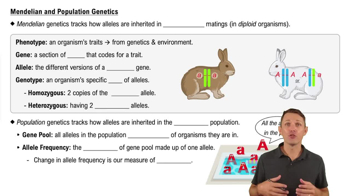
Mendelian genetics is the study of how traits are inherited through generations based on the principles established by Gregor Mendel. It involves understanding dominant and recessive alleles, genotype versus phenotype, and the segregation and independent assortment of genes during gamete formation. This framework is essential for predicting the ratios of offspring phenotypes in genetic crosses.
Recommended video:
04:26
Mendelian and Population Genetics

Linkage and Recombination

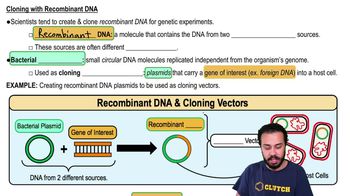
Linkage refers to the tendency of genes located close to each other on the same chromosome to be inherited together, while recombination occurs during meiosis when homologous chromosomes exchange genetic material. The degree of linkage can be quantified by the recombination frequency, which indicates the proportion of offspring that exhibit recombinant phenotypes. A lower recombination frequency suggests that genes are linked, while a higher frequency indicates they are unlinked.
Recommended video:
Guided course
03:41
Cloning with Recombinant DNA

Punnett Squares and Phenotypic Ratios

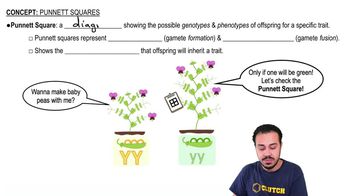
Punnett squares are a tool used to predict the genotypic and phenotypic ratios of offspring from a genetic cross. By organizing the possible gametes from each parent, one can visualize the expected ratios of different traits in the offspring. In this scenario, calculating the expected ratios based on the unlinked genes helps determine the likelihood of observing specific phenotypes, which can then be compared to actual results to assess gene linkage.
Recommended video:
Guided course
01:37
Punnett Squares
Related Practice
Textbook Question
Tim and Jan both have freckles but their son Mike does not. Show with a Punnett square how this is possible. If Tim and Jan have two more children, what is the probability that both will have freckles?
1066
views
Textbook Question

Both Tim and Jan have a widow's peak (see Module 9.8), but Mike has a straight hairline.

What are their genotypes?

What is the probability that Tim and Jan's next child will have freckles and a straight hairline?

949
views
Textbook Question
In rabbits, black hair depends on a dominant allele, B, and brown hair on a recessive allele, b. Short hair is due to a dominant allele, S, and long hair to a recessive allele, s. If a true-breeding black short-haired male is mated with a brown long-haired female, describe their offspring. What will be the genotypes of the offspring? If two of these F1 rabbits are mated, what phenotypes would you expect among their offspring? In what proportions?
3560
views
Textbook Question

A series of matings shows that the recombination frequency between the black-body gene and the gene for dumpy (shortened) wings is 36%. The recombination frequency between purple eyes and dumpy wings is 41%. What is the sequence of these three genes on the chromosome?

1340
views
Textbook Question

A couple are both phenotypically normal, but their son suffers from hemophilia, a sex-linked recessive disorder.

What fraction of their children are likely to suffer from hemophilia?

What fraction are likely to be carriers?

1423
views
Textbook Question
Why do more men than women have colorblindness?
997
views