
Pearson+ LogoPearson+ Logo
Ch. 9 Patterns of Inheritance
Taylor - Campbell Biology: Concepts & Connections 10th Edition
Taylor, Simon, Dickey, Hogan10th EditionCampbell Biology: Concepts & ConnectionsISBN: 9780136538783Not the one you use?Change textbook
Chapter 9, Problem 7

Both Tim and Jan have a widow's peak (see Module 9.8), but Mike has a straight hairline.
What are their genotypes?
What is the probability that Tim and Jan's next child will have freckles and a straight hairline?

Verified step by step guidance
1
Determine the inheritance pattern of the widow's peak trait. Widow's peak is a dominant trait (W), while a straight hairline is recessive (w). Since both Tim and Jan have a widow's peak, their genotypes could be either WW (homozygous dominant) or Ww (heterozygous). Mike, who has a straight hairline, must have the genotype ww (homozygous recessive).
Analyze the genotypes of Tim and Jan based on their child Mike. Since Mike has a straight hairline (ww), both Tim and Jan must carry at least one recessive allele (w). Therefore, their genotypes are Ww (heterozygous).
Determine the inheritance pattern of freckles. Freckles are also a dominant trait (F), while the absence of freckles is recessive (f). If the problem does not specify whether Tim and Jan have freckles, assume they are heterozygous (Ff) for this trait to account for all possibilities.
Set up a Punnett square for each trait. For the widow's peak/straight hairline trait, cross Ww (Tim) with Ww (Jan). For the freckles trait, cross Ff (Tim) with Ff (Jan). This will allow you to calculate the probabilities of each genotype and phenotype for their offspring.
Combine the probabilities of the two traits. To find the probability that Tim and Jan's next child will have freckles (F_) and a straight hairline (ww), multiply the probability of having freckles (F_) from the freckles Punnett square by the probability of having a straight hairline (ww) from the widow's peak Punnett square.

Verified video answer for a similar problem:

This video solution was recommended by our tutors as helpful for the problem above.
Video duration:
1m
Was this helpful?

Key Concepts

Here are the essential concepts you must grasp in order to answer the question correctly.

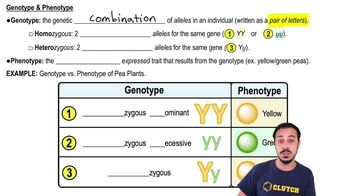
Genotype and Phenotype

Genotype refers to the genetic makeup of an organism, specifically the alleles it possesses for a particular trait. Phenotype, on the other hand, is the observable expression of those genes, influenced by both genotype and environmental factors. In this context, Tim and Jan's widow's peak is a phenotypic trait resulting from their genotypes.
Recommended video:
Guided course
06:36
Genotype & Phenotype

Inheritance Patterns

Inheritance patterns describe how traits are passed from parents to offspring, often explained through Mendelian genetics. Traits can be dominant or recessive, with dominant traits expressed in the phenotype even if only one allele is present. Understanding these patterns is crucial for predicting the likelihood of traits, such as freckles and hairline shape, in their children.
Recommended video:
Guided course
01:02
Autosomal Inheritance

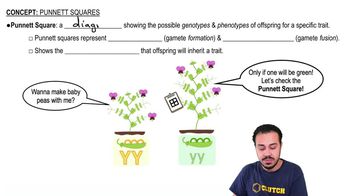
Punnett Squares

A Punnett square is a diagram used to predict the genetic outcomes of a cross between two organisms. By mapping the possible gametes from each parent, it allows for the calculation of probabilities for various genotypes and phenotypes in the offspring. This tool is essential for determining the likelihood of Tim and Jan's child inheriting specific traits like freckles and hairline shape.
Recommended video:
Guided course
01:37
Punnett Squares
Related Practice
Textbook Question

Two fruit flies with eyes of the usual red color are crossed, and their offspring are as follows: 77 red-eyed males, 71 ruby-eyed males, 152 red-eyed females. The allele for ruby eyes is

a. Autosomal (carried on an autosome) and dominant

b. Autosomal and recessive

c. Sex-linked and dominant

d. Sex-linked and recessive

1142
views
Textbook Question

A man with type B blood and a woman who has type A blood could have children of which of the following phenotypes?

a. A or B only

b. AB only

c. AB or O

d. A, B, AB, or O

1660
views
Textbook Question
Tim and Jan both have freckles but their son Mike does not. Show with a Punnett square how this is possible. If Tim and Jan have two more children, what is the probability that both will have freckles?
1066
views
Textbook Question
In rabbits, black hair depends on a dominant allele, B, and brown hair on a recessive allele, b. Short hair is due to a dominant allele, S, and long hair to a recessive allele, s. If a true-breeding black short-haired male is mated with a brown long-haired female, describe their offspring. What will be the genotypes of the offspring? If two of these F1 rabbits are mated, what phenotypes would you expect among their offspring? In what proportions?
3560
views
Textbook Question

A fruit fly with a gray body and red eyes (genotype BbPp) is mated with a fly having a black body and purple eyes (genotype bbpp).

What ratio of offspring would you expect if the body-color and eye-color genes are on different chromosomes (unlinked)?

When this mating is actually carried out, most of the offspring look like the parents, but 3% have a gray body and purple eyes, and 3% have a black body and red eyes.

Are these genes linked or unlinked?

What is the recombination frequency?

1418
views
Textbook Question

A series of matings shows that the recombination frequency between the black-body gene and the gene for dumpy (shortened) wings is 36%. The recombination frequency between purple eyes and dumpy wings is 41%. What is the sequence of these three genes on the chromosome?

1340
views