
Pearson+ LogoPearson+ Logo
Ch. 9 Patterns of Inheritance
Taylor - Campbell Biology: Concepts & Connections 10th Edition
Taylor, Simon, Dickey, Hogan10th EditionCampbell Biology: Concepts & ConnectionsISBN: 9780136538783Not the one you use?Change textbook
Chapter 9, Problem 6

Tim and Jan both have freckles but their son Mike does not. Show with a Punnett square how this is possible. If Tim and Jan have two more children, what is the probability that both will have freckles?

Verified step by step guidance
1
Identify the genotype of Tim and Jan for the freckles trait, assuming freckles (F) is a dominant trait and no freckles (f) is recessive. Since both Tim and Jan have freckles but their son Mike does not, both parents must be heterozygous (Ff).
Set up a Punnett square with both parents' genotypes. Place Tim's possible gametes (F and f) on the top of the square and Jan's possible gametes (F and f) on the side of the square.
Fill in the Punnett square by combining the gametes from each parent. This will result in four possible genotypes for their children: FF, Ff, Ff, and ff.
Analyze the Punnett square to determine the probability of each genotype. The genotypes FF and Ff both result in children with freckles, while ff results in a child without freckles. Since there are three squares with freckles (FF, Ff, Ff) and one without (ff), the probability of a child having freckles is 3/4.
Calculate the probability that both of the next two children will have freckles. Since each child has a 3/4 chance of having freckles, multiply these probabilities together: (3/4) * (3/4) = 9/16.

Verified video answer for a similar problem:

This video solution was recommended by our tutors as helpful for the problem above.
Video duration:
1m
Was this helpful?

Key Concepts

Here are the essential concepts you must grasp in order to answer the question correctly.

Punnett Square

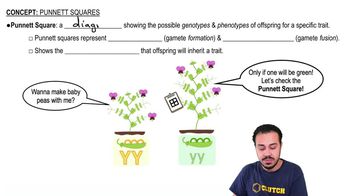
A Punnett square is a diagram used in genetics to predict the genotypes of offspring from two parents. It displays the possible combinations of alleles from each parent, allowing for the visualization of inheritance patterns. In this case, it will help illustrate how Tim and Jan, both with freckles, can have a child without them, indicating the presence of recessive alleles.
Recommended video:
Guided course
01:37
Punnett Squares

Dominant and Recessive Alleles

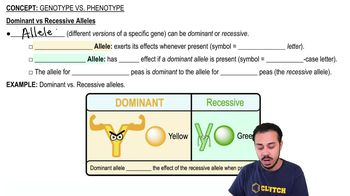
In genetics, traits are often determined by alleles, which can be dominant or recessive. A dominant allele masks the effect of a recessive allele when both are present. Freckles are typically a dominant trait, meaning that if Tim and Jan both carry a recessive allele for no freckles, their son Mike could inherit two recessive alleles, resulting in no freckles.
Recommended video:
Guided course
03:39
Dominant vs. Recessive Alleles

Probability in Genetics

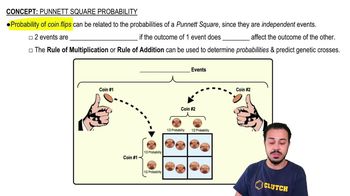
Probability in genetics refers to the likelihood of certain traits being expressed in offspring based on parental genotypes. After determining the genotypes of Tim and Jan, one can calculate the probability of their next two children having freckles. This involves using the ratios derived from the Punnett square to assess the chances of each child inheriting the dominant or recessive alleles.
Recommended video:
Guided course
03:38
Punnett Square Probability
Related Practice
Textbook Question

Edward was found to be heterozygous (Ss) for sickle-cell trait. The alleles represented by the letters S and s are

a. Linked

b. On homologous chromosomes

c. Both present in each of Edward's sperm cells

d. On the same chromosome but far apart

1503
views
Textbook Question

Two fruit flies with eyes of the usual red color are crossed, and their offspring are as follows: 77 red-eyed males, 71 ruby-eyed males, 152 red-eyed females. The allele for ruby eyes is

a. Autosomal (carried on an autosome) and dominant

b. Autosomal and recessive

c. Sex-linked and dominant

d. Sex-linked and recessive

1142
views
Textbook Question

A man with type B blood and a woman who has type A blood could have children of which of the following phenotypes?

a. A or B only

b. AB only

c. AB or O

d. A, B, AB, or O

1660
views
Textbook Question

Both Tim and Jan have a widow's peak (see Module 9.8), but Mike has a straight hairline.

What are their genotypes?

What is the probability that Tim and Jan's next child will have freckles and a straight hairline?

949
views
Textbook Question
In rabbits, black hair depends on a dominant allele, B, and brown hair on a recessive allele, b. Short hair is due to a dominant allele, S, and long hair to a recessive allele, s. If a true-breeding black short-haired male is mated with a brown long-haired female, describe their offspring. What will be the genotypes of the offspring? If two of these F1 rabbits are mated, what phenotypes would you expect among their offspring? In what proportions?
3560
views
Textbook Question

A fruit fly with a gray body and red eyes (genotype BbPp) is mated with a fly having a black body and purple eyes (genotype bbpp).

What ratio of offspring would you expect if the body-color and eye-color genes are on different chromosomes (unlinked)?

When this mating is actually carried out, most of the offspring look like the parents, but 3% have a gray body and purple eyes, and 3% have a black body and red eyes.

Are these genes linked or unlinked?

What is the recombination frequency?

1418
views