Pearson+ LogoPearson+ Logo
Ch. 9 Patterns of Inheritance
Taylor - Campbell Biology: Concepts & Connections 10th Edition
Taylor, Simon, Dickey, Hogan10th EditionCampbell Biology: Concepts & ConnectionsISBN: 9780136538783Not the one you use?Change textbook
Chapter 9, Problem 15

Heather was surprised to discover she suffered from red-green colorblindness. She told her biology professor, who said, 'Your father is colorblind, too, right?' How did her professor know this? Why did her professor not say the same thing to the colorblind males in the class?

Verified step by step guidance
1
Understand the genetic basis of red-green colorblindness: Red-green colorblindness is primarily caused by mutations in the X chromosome. Since females have two X chromosomes (XX) and males have one X and one Y chromosome (XY), the inheritance patterns differ between genders.
Recognize the inheritance pattern in females: For a female to express red-green colorblindness, she must inherit the defective gene on the X chromosome from both parents. This is because having one normal X chromosome can usually compensate for the defective one, preventing the expression of colorblindness.
Consider the inheritance from the father: Since Heather's professor mentioned her father, it implies that her father must have the colorblind gene on his X chromosome. Males only have one X chromosome, and if it carries the colorblind gene, they will express the condition. Heather must have inherited this X chromosome from her father.
Explain why the professor did not mention fathers for colorblind males: Males only need one defective gene on their X chromosome to be colorblind, which they inherit from their mothers, as fathers pass on their Y chromosome to male offspring. Therefore, the status of the father's colorblindness is irrelevant to the male's condition.
Summarize the genetic transmission: Heather's professor inferred her father's condition based on the understanding that Heather, being female, would need two copies of the defective gene to be colorblind—one from her mother and one from her father. This is not the case for males, who only need one defective gene from their mother.

Verified video answer for a similar problem:

This video solution was recommended by our tutors as helpful for the problem above.
Video duration:
2m
Was this helpful?

Key Concepts

Here are the essential concepts you must grasp in order to answer the question correctly.

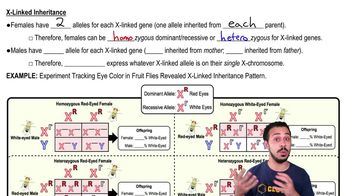
X-Linked Inheritance

Red-green colorblindness is primarily inherited in an X-linked recessive pattern. This means that the gene responsible for this condition is located on the X chromosome. Males, having only one X chromosome, are more likely to express the trait if they inherit the affected X. Females, with two X chromosomes, must inherit two copies of the affected gene to express colorblindness.
Recommended video:
Guided course
07:23
X-Linked Inheritance

Genetic Carrier Status

In X-linked inheritance, females can be carriers of the colorblindness gene without expressing the trait themselves. A carrier has one normal X chromosome and one affected X chromosome. If Heather's father is colorblind, it indicates that he has the affected X chromosome, which he passed to Heather, making it likely that she is a carrier if her mother has a normal X chromosome.
Recommended video:

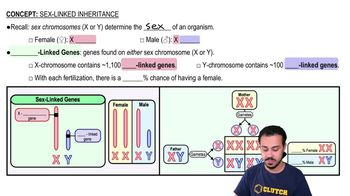
Sex-Linked Traits

Sex-linked traits, such as colorblindness, are associated with genes located on sex chromosomes. Since males have one X and one Y chromosome, they are more susceptible to expressing recessive traits linked to the X chromosome. In contrast, females have two X chromosomes, which provides a higher chance of having a normal allele that can mask the expression of the recessive trait, explaining why the professor did not make the same assumption about colorblind males in the class.
Recommended video:
Guided course
04:17
Sex-Linked Inheritance
Related Practice
Textbook Question
Why do more men than women have colorblindness?
997
views
Textbook Question

In fruit flies, the genes for wing shape and body stripes are linked. In a fly whose genotype is WwSs, W is linked to S, and w is linked to s. Show how this fly can produce gametes containing four different combinations of alleles.

Which are parental-type gametes?

Which are recombinant gametes? How are the recombinants produced?

1551
views
Textbook Question
Skin color in humans is at least partially hereditary; dark-skinned parents tend to have dark-skinned children. But humans come in a range of skin tones. Which extension of Mendel's model accounts for the hereditary variation in human skin color?
1330
views
Textbook Question
In 1981, a stray black cat with unusual rounded, curled-back ears was adopted by a family in Lakewood, California. Suppose you owned the first curl cat and wanted to breed it to develop a true-breeding variety. Describe tests that would determine whether the curl gene is dominant or recessive and whether it is autosomal or sex-linked. Explain why you think your tests would be conclusive. Describe a test to determine that a cat is true-breeding.
1136
views
Textbook Question

The breakthrough that led Bateson and Punnett to recognize the existence of linked genes was the appearance of unexpected results after they crossed double heterozygous pea plants (PpLl) with each other. Imagine that you have a group of Labrador retrievers that are all heterozygous for both coat color and blindness (BbNn). If you used this group of dogs to produce 160 puppies, how many puppies of each phenotype do you expect to get if the genes are not linked? How would the results differ if the genes are in fact linked?

1154
views