
Pearson+ LogoPearson+ Logo
Ch. 9 Patterns of Inheritance
Taylor - Campbell Biology: Concepts & Connections 10th Edition
Taylor, Simon, Dickey, Hogan10th EditionCampbell Biology: Concepts & ConnectionsISBN: 9780136538783Not the one you use?Change textbook
Chapter 9, Problem 14

Skin color in humans is at least partially hereditary; dark-skinned parents tend to have dark-skinned children. But humans come in a range of skin tones. Which extension of Mendel's model accounts for the hereditary variation in human skin color?

Verified step by step guidance
1
Understand that Mendel's basic model of inheritance involves simple dominant and recessive traits, which doesn't fully explain the continuous variation seen in traits like human skin color.
Recognize that human skin color is not determined by a single gene, but rather by multiple genes contributing to the final phenotype, a concept known as polygenic inheritance.
Learn that each gene involved in this polygenic system can have multiple alleles, and the cumulative effect of these alleles results in the wide range of human skin colors.
Consider the influence of environmental factors such as sunlight exposure, which can also affect melanin production in the skin, adding another layer of complexity to the genetic determination of skin color.
Explore how the interaction between multiple genes and environmental factors fits into an extension of Mendel’s model known as quantitative trait locus (QTL) analysis, which helps in understanding how multiple genetic and environmental factors influence complex traits like skin color.

Verified video answer for a similar problem:

This video solution was recommended by our tutors as helpful for the problem above.
Video duration:
1m
Was this helpful?

Key Concepts

Here are the essential concepts you must grasp in order to answer the question correctly.

Mendelian Genetics

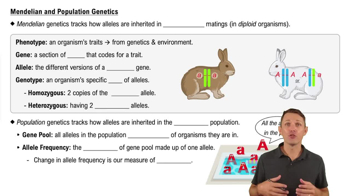
Mendelian genetics is the study of how traits are inherited through generations, based on the principles established by Gregor Mendel. It focuses on discrete traits controlled by single genes with dominant and recessive alleles. However, this model does not fully explain complex traits, such as skin color, which are influenced by multiple genes.
Recommended video:
04:26
Mendelian and Population Genetics

Polygenic Inheritance

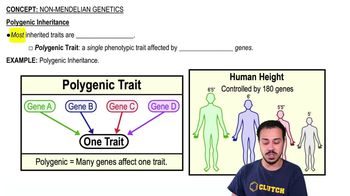
Polygenic inheritance refers to the phenomenon where multiple genes contribute to a single trait, resulting in a continuous range of phenotypes. In the case of human skin color, several genes interact to produce various shades, leading to the observed diversity. This model explains why offspring can exhibit a range of skin tones, even when parents have similar complexions.
Recommended video:
Guided course
02:27
Polygenic Inheritance

Environmental Influence on Phenotype

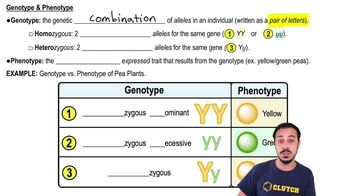
Environmental factors can significantly influence the expression of genetic traits, a concept known as phenotypic plasticity. For skin color, factors such as sun exposure, diet, and overall health can affect melanin production, leading to variations in skin tone. This interaction between genetics and environment is crucial for understanding the full spectrum of human skin color.
Recommended video:
Guided course
06:36
Genotype & Phenotype
Related Practice
Textbook Question

A couple are both phenotypically normal, but their son suffers from hemophilia, a sex-linked recessive disorder.

What fraction of their children are likely to suffer from hemophilia?

What fraction are likely to be carriers?

1423
views
Textbook Question
Why do more men than women have colorblindness?
997
views
Textbook Question

In fruit flies, the genes for wing shape and body stripes are linked. In a fly whose genotype is WwSs, W is linked to S, and w is linked to s. Show how this fly can produce gametes containing four different combinations of alleles.

Which are parental-type gametes?

Which are recombinant gametes? How are the recombinants produced?

1551
views
Textbook Question
Heather was surprised to discover she suffered from red-green colorblindness. She told her biology professor, who said, 'Your father is colorblind, too, right?' How did her professor know this? Why did her professor not say the same thing to the colorblind males in the class?
888
views
Textbook Question
In 1981, a stray black cat with unusual rounded, curled-back ears was adopted by a family in Lakewood, California. Suppose you owned the first curl cat and wanted to breed it to develop a true-breeding variety. Describe tests that would determine whether the curl gene is dominant or recessive and whether it is autosomal or sex-linked. Explain why you think your tests would be conclusive. Describe a test to determine that a cat is true-breeding.
1136
views
Textbook Question

The breakthrough that led Bateson and Punnett to recognize the existence of linked genes was the appearance of unexpected results after they crossed double heterozygous pea plants (PpLl) with each other. Imagine that you have a group of Labrador retrievers that are all heterozygous for both coat color and blindness (BbNn). If you used this group of dogs to produce 160 puppies, how many puppies of each phenotype do you expect to get if the genes are not linked? How would the results differ if the genes are in fact linked?

1154
views