Pearson+ LogoPearson+ Logo
Ch. 9 Patterns of Inheritance
Taylor - Campbell Biology: Concepts & Connections 10th Edition
Taylor, Simon, Dickey, Hogan10th EditionCampbell Biology: Concepts & ConnectionsISBN: 9780136538783Not the one you use?Change textbook
Chapter 9, Problem 17

The breakthrough that led Bateson and Punnett to recognize the existence of linked genes was the appearance of unexpected results after they crossed double heterozygous pea plants (PpLl) with each other. Imagine that you have a group of Labrador retrievers that are all heterozygous for both coat color and blindness (BbNn). If you used this group of dogs to produce 160 puppies, how many puppies of each phenotype do you expect to get if the genes are not linked? How would the results differ if the genes are in fact linked?

Verified step by step guidance
1
Step 1: Understand the problem. The problem involves two genes (B and N) in Labrador retrievers, each with two alleles. B (dominant) determines coat color, and N (dominant) determines blindness. The dogs are heterozygous for both traits (BbNn). You are tasked with predicting the phenotypic ratios of 160 puppies under two scenarios: (1) the genes are not linked, and (2) the genes are linked.
Step 2: For the unlinked genes scenario, apply Mendel's law of independent assortment. This means the alleles for coat color (B and b) and blindness (N and n) segregate independently during gamete formation. Use a dihybrid Punnett square to determine the phenotypic ratios. The phenotypes are: (1) Black coat, not blind (B_N_), (2) Black coat, blind (B_nn), (3) Brown coat, not blind (bbN_), and (4) Brown coat, blind (bbnn).
Step 3: Calculate the expected phenotypic ratios for unlinked genes. From the Punnett square, the phenotypic ratio for a dihybrid cross (BbNn x BbNn) is 9:3:3:1. This means 9/16 of the offspring will have the first phenotype, 3/16 the second, 3/16 the third, and 1/16 the fourth. Multiply these fractions by the total number of puppies (160) to determine the expected number of puppies for each phenotype.
Step 4: For the linked genes scenario, consider that the genes are located close together on the same chromosome and are inherited together unless crossing over occurs. This would alter the phenotypic ratios. If no crossing over occurs, only the parental phenotypes (Black coat, not blind and Brown coat, blind) will be observed. If crossing over occurs, recombinant phenotypes (Black coat, blind and Brown coat, not blind) will also appear, but in lower frequencies. The exact ratios depend on the recombination frequency, which is not provided in the problem.
Step 5: Summarize the differences. For unlinked genes, the phenotypic ratios follow the 9:3:3:1 pattern. For linked genes, the ratios deviate from this pattern, with more parental phenotypes and fewer recombinant phenotypes. To calculate exact numbers for the linked scenario, additional information about the recombination frequency would be needed.

Verified video answer for a similar problem:

This video solution was recommended by our tutors as helpful for the problem above.
Video duration:
2m
Was this helpful?

Key Concepts

Here are the essential concepts you must grasp in order to answer the question correctly.

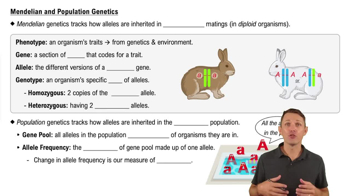
Mendelian Genetics

Mendelian genetics is the study of how traits are inherited through generations based on the principles established by Gregor Mendel. It involves understanding dominant and recessive alleles, as well as the segregation and independent assortment of genes during gamete formation. This framework allows us to predict the phenotypic ratios of offspring from parental genotypes, particularly in dihybrid crosses.
Recommended video:
04:26
Mendelian and Population Genetics

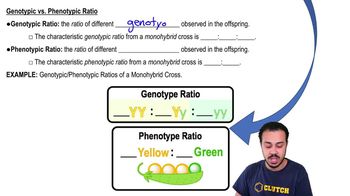
Phenotypic Ratios

Phenotypic ratios represent the relative frequencies of different phenotypes in the offspring resulting from a genetic cross. In a dihybrid cross of two heterozygous individuals (BbNn), the expected phenotypic ratio for unlinked genes is typically 9:3:3:1. This ratio helps in predicting the distribution of traits, such as coat color and blindness in the puppies, based on the combinations of alleles inherited from the parents.
Recommended video:
Guided course
02:48
Genotypic vs. Phenotypic Ratio

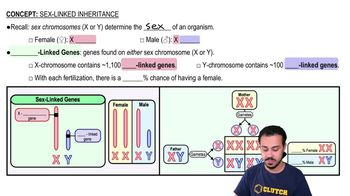
Linked Genes

Linked genes are genes that are located close to each other on the same chromosome and tend to be inherited together during meiosis. When genes are linked, the expected phenotypic ratios deviate from those predicted by Mendelian genetics, as they do not assort independently. This can lead to fewer recombinant phenotypes in the offspring, affecting the overall distribution of traits, such as coat color and blindness in the Labrador puppies.
Recommended video:
Guided course
04:17
Sex-Linked Inheritance