
Pearson+ LogoPearson+ Logo
Ch. 9 Patterns of Inheritance
Taylor - Campbell Biology: Concepts & Connections 10th Edition
Taylor, Simon, Dickey, Hogan10th EditionCampbell Biology: Concepts & ConnectionsISBN: 9780136538783Not the one you use?Change textbook
Chapter 9, Problem 16

In 1981, a stray black cat with unusual rounded, curled-back ears was adopted by a family in Lakewood, California. Suppose you owned the first curl cat and wanted to breed it to develop a true-breeding variety. Describe tests that would determine whether the curl gene is dominant or recessive and whether it is autosomal or sex-linked. Explain why you think your tests would be conclusive. Describe a test to determine that a cat is true-breeding.

Verified step by step guidance
1
First, determine if the curl gene is dominant or recessive by breeding the original curled-ear cat with a normal-eared cat. If any of the offspring have curled ears, the gene is likely dominant. If none do, then it may be recessive, and a second generation (F2) might need to be examined by breeding the F1 offspring together to see if the trait reappears.
Next, to test if the curl gene is autosomal or sex-linked, observe the distribution of the trait among male and female offspring. If the trait appears equally in both males and females, it is likely autosomal. If the trait appears predominantly in one sex, it may be sex-linked. This can be further tested by breeding males and females separately with normal-eared cats and observing the trait distribution in their offspring.
To confirm your findings from the initial tests, repeat the breeding experiments with multiple pairs to ensure consistent results across different genetic backgrounds and to rule out any environmental influences or anomalies in the initial breeding.
To determine if a cat is true-breeding for the curled-ear trait, breed two cats that both have curled ears. If all their offspring also have curled ears over several generations, it suggests that the parents are homozygous for the curl gene, indicating a true-breeding line.
Document all breeding experiments, offspring, and traits observed meticulously. This data will provide a solid foundation for drawing conclusions about the genetic nature of the curled-ear trait and will be invaluable for developing a true-breeding variety of curl cats.

Verified video answer for a similar problem:

This video solution was recommended by our tutors as helpful for the problem above.
Video duration:
1m
Was this helpful?

Key Concepts

Here are the essential concepts you must grasp in order to answer the question correctly.

Dominance in Genetics

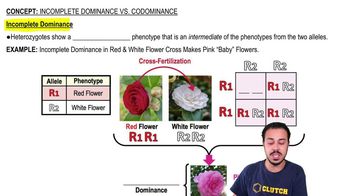
Dominance refers to the relationship between alleles of a gene, where one allele can mask the expression of another. In the case of the curl gene, if the trait appears in the offspring when only one parent carries the curl allele, it suggests that the curl gene is dominant. Conversely, if the trait only appears when both parents carry the curl allele, it indicates that the gene is recessive.
Recommended video:
Guided course
03:09
Incomplete Dominance

Autosomal vs. Sex-linked Inheritance

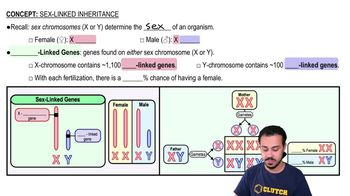
Autosomal inheritance involves genes located on non-sex chromosomes, while sex-linked inheritance pertains to genes found on sex chromosomes (X or Y). To determine if the curl gene is autosomal or sex-linked, one could analyze the inheritance patterns in offspring from crosses between male and female cats, observing if the trait is equally expressed in both sexes or if it shows a bias towards one sex.
Recommended video:
Guided course
04:17
Sex-Linked Inheritance

True-breeding

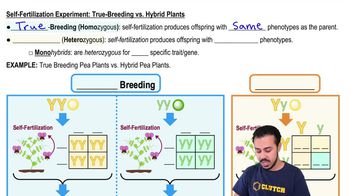
A true-breeding organism consistently produces offspring with the same phenotype when self-fertilized or crossed with another true-breeding individual of the same phenotype. To test if a cat is true-breeding for the curl trait, one could breed it with another curl cat and observe the offspring. If all offspring exhibit the curl trait, the parent is likely true-breeding; if there is variation, it suggests the parent carries a recessive allele.
Recommended video:
Guided course
05:48
Self-Fertilization Experiment: True-Breeding vs. Hybrid Plants